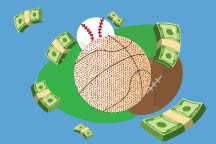

An unprecedented rise in sports betting, in less than a decade, has led to its promotion in every corner of the sports world. Commercials, jersey patches, networks and more have been infiltrated by big gambling companies, making it hard to watch anything sports-related without being bombarded with prop bets and live odds.
This issue has soared in recent years, with teams and leagues partnering with these companies to push the “best” parlays of the game during broadcasts. The taboo around sports gambling has been completely lost in our culture. At what point do we realize how annoying and predatory this business model is? With widespread legalization, sports gambling has evolved into a parasite on the sports world, threatening both competitive integrity and the financial wellbeing of fans.
I am not saying sports gambling should be prohibited. Throwing five dollars on the Pirates winning a game every once in a while is not a terrible thing. The problem is the near-total lack of regulation. We’re living in the Wild West of sports gambling, and the consequences are already visible. A rise in players and fighters fixing games and fights has been a worrying trend in recent years. The NBA and UFC have faced troubling legal cases surrounding the talent in their respective sports.
Adam Silver is no stranger when it comes to sports gambling. He was ecstatic about the Supreme Court’s decision, legalizing it in 2018, and he actively encouraged states to adopt it. The NBA has two official sports gambling sponsors, DraftKings and FanDuel, which became co-official partners starting in 2021.
With this partnership, the NBA and DraftKings started the “NBABet” stream, which was an alternative weekly stream where odds and bets would be discussed. This idea slowly faded and was instead fully integrated into regular programming on the NBA app 24/7. This includes dedicated betting podcasts and analyses, and odds always being on the tickers/screen.
Terry Rozier and Jontay Porter, former NBA players, were arrested in 2025 for heading an insider information ring that allowed sports gamblers to place wagers on NBA games with non-public information that they had obtained. Following that, Rozier told gamblers he would come out early from a game in March 2023 so that bettors would place wagers on his under for points, rebounds, assists, etc. Porter did the same thing for two games in the 2024 season; he was charged and pleaded guilty.
The funniest part of this was a segment by Get Up on ESPN—who are official partners with the NBA—surrounding this case. During this segment, the bottom ticker showed both the odds, O/U, and spread of multiple games. In the bottom right, an ad for ESPN’s own ESPNBet promoted its “Bet $10, Get $100 free” offer, while Mike Greenberg stated, “It was something networks like ESPN would stay far away from. Those days are obviously long behind us.” The production team quickly removed the bottom ticker and ad for ESPNBet after he said that.
Issues have also arisen in the UFC, with a fight being fully cancelled, and another getting the FBI involved following its conclusion.
In early November 2025, a bout between Isaac Dulgarian—a -250 favorite—and Yadier del Valle was set to happen when Dana White was told by Integrity Compliance 360 that suspicious betting activity surrounding Dulgarian losing in the first round was on their watch. Dulgarian denied any involvement and then promptly lost in the first round by submission, getting cut from the promotion.
Following that incident, the UFC learned from its mistakes and fully cancelled a fight on Jan. 24 between Alexander Hernandez and Michael Johnson due to suspicious gambling activity.
But the UFC is no stranger to promoting gambling on its product. Something almost incomprehensible in the gambling world was the UFC’s former policy on its own talent betting. Up until October 2022, the UFC did not prohibit fighters, coaches or their teams from gambling on bouts, including those they were involved in.
TKO Group Holdings—UFC’s parent company—inked a deal with Polymarket to become an official partner in 2026. The deal now allows the integration of real-time betting momentum data into live broadcasts via a “fan prediction scoreboard,” allowing fans to trade fight outcomes like stocks during events. Instead of traditionally placing a bet on a fighter to win or lose, you can now buy his “stock” when it is “low” (losing) and sell when it’s “high” (winning).
Polymarkets’ model of gambling is sweeping the sports world and the overall nation. An advantage they have is the exploitation of a loophole in the sports gambling sphere, which is being able to operate in all 50 states, unlike regular sportsbooks that are restricted in 12 states. Its model lets users buy and sell “contracts” tied to the outcome of future events. A “Yes” contract on the Pirates winning a game might trade at 60 cents, which means the market believes a 60% chance of a win. If they win, your contract pays out $1. If they lose, it’s worth zero.
Other leagues, such as the NHL, MLB and MLS, have all become partners with Polymarket thanks to this workaround. Even individual athletes are getting involved; Giannis Antetokounmpo became a shareholder with Kalshi, another prediction market business.
Leagues embracing sports gambling and the mounting number of ads promoting gambling have led to certain demographics being exposed and hurt. Groups most affected are low-income earners and young men.
A study by the University of California San Diego showed that irresponsible gambling—spending around 10% of one’s income—is more prevalent among lower-income consumers than among higher-income earners. That same study states that “only 4% made money from online betting.” That is by design.
Online gambling platforms often ban or throttle frequent winners’ accounts. There is no “right to gamble.” Sports betting is a just a losing battle.
Rutgers University published a study that found around 70% of prop bets lose. But prop bets are still popular because of their great payout when they do hit, getting bettors addicted to finally hitting. Betting on sports has become more accessible than ever, making it easier for younger people to start early. The National Council of Problem Gambling found in their survey that “33% of 21–44-year-olds placed a sports bet before 21, versus 11% of 55+.”
Normalization of gambling and the high exposure towards younger audiences leads to a huge risk, as issues with addiction are heightened within a more vulnerable demographic.
All of this is to say that we are in a very chaotic time for gambling. Laws and regulations are increasingly being pushed to the state and nationwide levels, but progress is slow. The normalization of gambling—and the relentless advertising that fuels it—is creating a vulnerable new generation of bettors. Addiction risks are rising, integrity concerns are mounting, and the industry shows no signs of slowing down. Vegas may be fading, but gambling is thriving in ways far more pervasive, predatory and dangerous than in the past. As with anything, moderation is key.