

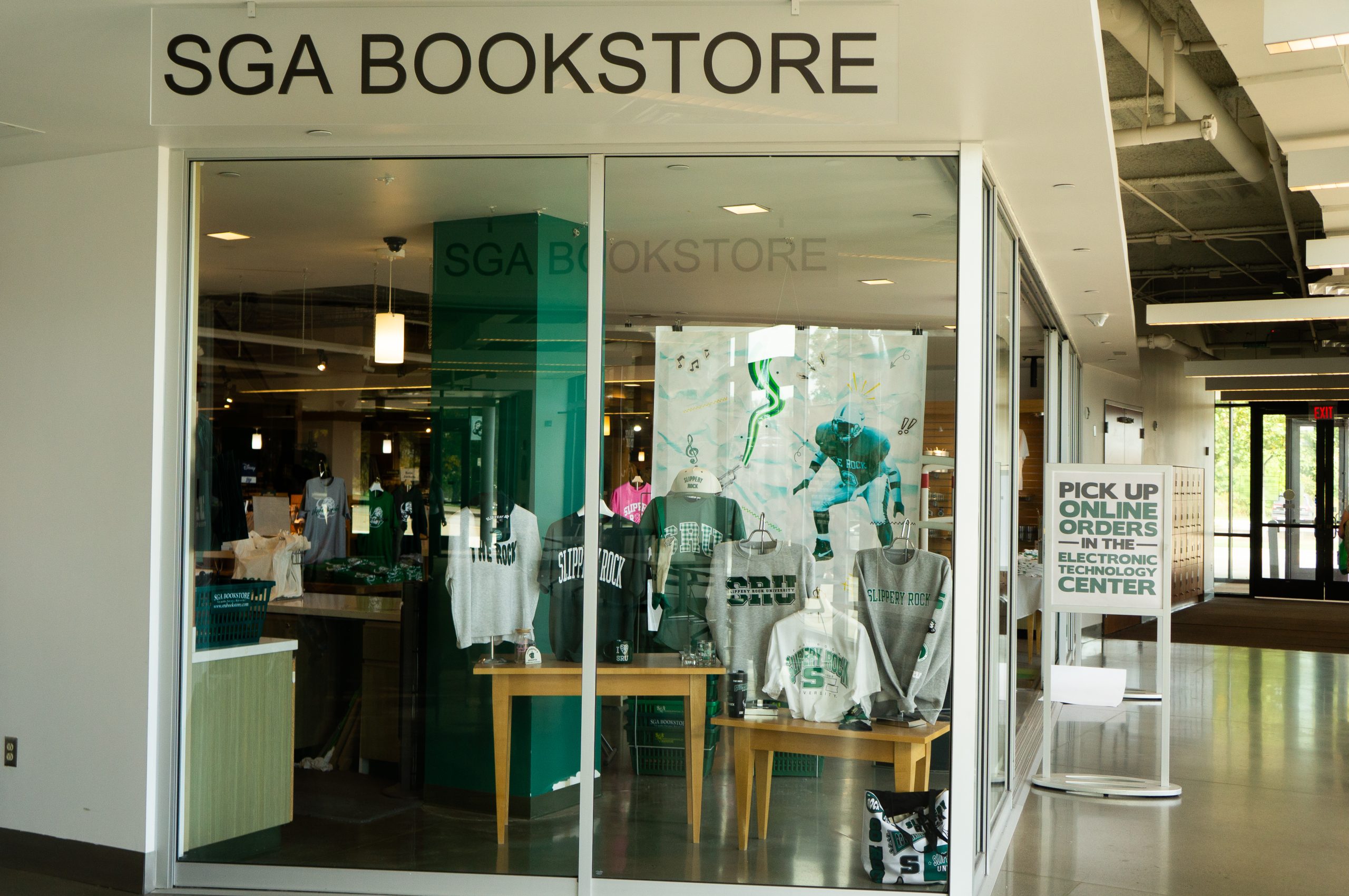

Slippery Rock Student Government Association (SRSGA) President Connor Pavlicko voiced his concerns about the Slippery Rock University (SRU) Sideline Store, which opened on Sept. 17.
SRU and Apparel partner BSN Sports launched the SRU Sideline Store, offering hundreds of customizable apparel options from brands such as Adidas, BSN Sports, New Balance, Carhartt and TravisMathew. The store is offering 20% off through Oct. 17.
Pavlicko oversees the SGA Bookstore alongside Wendy Leitera, Executive Director of SGA. He said that, while he was aware a sideline store was a possibility, he was surprised by its launch.
“I have known about BSN potentially opening a sideline store for a couple of months and we were kind of blindsided by it,” Pavlicko said. “There was no communication made to students. Other than the original email that we got, I found out about the launch of the sideline store at the same time as every other student did. Which is fine. That’s not a problem.”
Because the SRU Sideline Store sells apparel similar to products available through the SGA Bookstore, Pavlicko said he is concerned that this could result in reduced profits to fund student initiatives.
“It feels a little bit like a direct competitor to the SGA Bookstore because of the way that the bookstore and BSN are set up; the bookstore takes all that profit that they gain from the community…and that profit is then reinvested into students,” Pavlicko said.
Roberta Page, Director of Athletics, said that the SRU Sideline Store was not intended to be a competitor to the SGA Bookstore, and that the sideline store carries athletic-specific apparel items not offered at the SGA Bookstore.
“We’re not here to compete with each other, we’re here to work together. We’ll compete against our competitors, but I don’t think we should be competing against each other,” Page said.
“We’re all in this together, and we need to be in it together,” she said. “A lot of the teams have sideline stores to do individual things that are applicable to them as a team. This is just a way for some of their parents or people to get specific things that they can’t get over at the bookstore.”
Purpose of the sideline store
Page said the sideline store was a small part of a larger contract between SRU and BSN Sports and that the primary purpose of the agreement was to provide apparel for athletics while maintaining low university costs.
“The Sideline store was a piece of the project, but it’s not the primary intent of the contract. Most of it was for uniforms and apparel for the athletics program,” Page said.
Controller John Simon said that BSN replaced SportsLocker, the university’s previous athletic apparel vendor. He said BSN provides SRU access to a company with a national presence and a larger collegiate market.
“We were able to get a contract with this company that has a national footprint. They have 12,000 schools, the biggest collegiate market and the most collegiate programs in the market, and this gives the athletics program at Slippery Rock a national footprint,” Simon said.
Simon said that online sideline stores were also available during the partnership with SportsLocker, although they were primarily used for athletics.
“Under SportsLocker, there were online stores as well. That’s a key factor that I think is left out. They were mostly athletics at the time, but this is just a small byproduct of this contract,” Simon said.
Page said the increased attention surrounding the new store could be related to BSN’s larger presence and publicity.
“I think that because BSN is much bigger, when they put the items and the announcement out, it’s a bigger company than what we had, so of course their digital product was going to look different. But we’ve always had the sideline stores,” Page said.
Page and Simon said that the two stores serve different purposes. Simon said that, though both sell apparel, the sideline store offers customizable and sports-specific apparel, while the SGA Bookstore carries souvenirs and more universal apparel options.
“It’s just a different kind of thing. The bookstore just can’t have that kind of variety. And then the sideline store doesn’t have souvenirs; it doesn’t have a lot of the green and white that the bookstore has. So, they really should be working together and we should be promoting them together. If you’re on campus, stop at the bookstore. They have all these great things,” Simon said.
Simon noted that since the SGA Bookstore is a physical location, it serves as the primary store for students and families visiting campus.
“The bookstore is going to have things where you go in there and you touch it, you feel it; it’s brick and mortar. You go in there, you get your souvenirs; it’s great when people are on campus for orientation, anything like that,” Simon said. “They’re going to the bookstore. That’s the place to go.”
Page said she intends for customers to continue shopping at both stores.
“We want people buying from two locations: the bookstore and the sideline store. And then, it’s a win-win for everybody,” Page said.
Where the money goes
Pavlicko pressed that a core reason the SGA Bookstore exists is to create profit to be reinvested into the students and that 100% of bookstore revenue is reinvested into the student body.
“All of our projects, like the IM Field, the enhancements of the field, the golf simulators, the photo booth—and also, this isn’t really student facing, but logistical factors like maintenance, insurance—come out of SGA Bookstore revenue,” Pavlicko said.
According to Controller John Simon, profit from the SRU Sideline Store will be returned to the university to offset program costs.
“It’s going to come back…mostly to athletics, but to any initiative that the president really sees fit,” Simon said.
Page and Simon estimated that the sideline store will generate approximately $10,000 in revenue and approximately $1,000 in profit annually.
“I don’t want people to be misled that the sideline store makes millions of dollars. I think we’re estimating maybe $1,000 a year. It’s not a huge amount,” Page said.
Page said the SGA Bookstore generates most of its revenue through inclusive access, totaling approximately $2 million annually.
“The bookstore makes most of its money on inclusive access…they make about $2 million a year on that. So, I don’t think that this is going to make a dent in the bookstore revenue,” Simon said.
Simon said that reducing athletics expenses is one way the university attempts to limit costs for students.
“How can we keep tuition and fees low for students? We’re always thinking about that. How do we get there? This is one of those avenues that we use to do that,” Simon said. “By spending less on intercollegiate athletics, that allows us to charge less in fees and tuition.”
Page reiterated that the primary purpose of partnering with BSN was for its national presence rather than the sideline store or potential revenue.
“The sideline store is not why we went with BSN. That’s just, as John indicated, a small component. It was more with the contract of how it would save money, incentivize things that we’re doing through the athletic department and the campus as a whole, but that’s not the only reason why we partnered with BSN,” Page said. “The whole contract is really about brand awareness to give us a national platform, more-so than money.”
Communication concerns
Pavlicko also questioned why the SRU Sideline store received university-wide email promotion while the SGA Bookstore had previously been denied promotion for a sale.
The SGA Bookstore held an end-of-year Big Blowout Sale during the 2025-26 academic year. Pavlicko recalled requesting the sale to be publicized in an SRU Communications email and being told that the emails only included notices from campus operations and campus updates.
SGA later heard that the actual reason for the denial was because the promotion involved sales and solicitation, according to Pavlicko.
“We were told via word-of-mouth that the reason we got that response was because SRU does not include sales or solicitations in their campus-wide email communications,” Pavlicko said.
“We were ultimately almost running the same promotion that BSN was running in November. We were denied access to email communication, but when BSN opened their store, they had email communication,” he said. “They had the SRU Facebook, the SRU Instagram, the SRU homepage; everything was advertising 20% at BSN.”
Simon expressed that neither he nor Page were aware of the previous communication restriction.
“We weren’t aware of that, and I thank Connor for bringing that to our attention. The higher administration and the marketing director must have made that rule somewhere along the way. We didn’t know about it,” Simon said.
Page added that President Karen Riley was also unaware of the denial in email communication and that the policy was changed after it was brought to the university’s attention.
“The president of the university had no idea that that was a policy that was in effect, so that changed quick. As soon as she was made aware of that, she was able to get that changed. I had no idea,” Page said.
Contract
Pavlicko said that his next step was to review the contract between SRU and BSN Sports to decide if further action was necessary.
“I think that’s the first step to this is looking at that contract and seeing what it actually is and how we can make that the best possible outcome for students. I think that’s the ultimate goal: making sure that everything that happens within the university is the most feasible option for the student body.” Pavlicko said.
The SGA received the contract last Friday, Sept. 15, and is in the process of reviewing it, according to Pavlicko.
Page said the SGA had been aware that SRU was negotiating with BSN for approximately a year, but that contract details could not be shared until the contract was finalized in March.
“Once it was done—I think it was done in March—we started to communicate. We said, ‘hey, here’s the contract, here’s what’s in the contract.’ The sideline store was an afterthought, really,” Simon said.
Page pressed that the opening of the sideline store was never intended to be secretive and that she values open communication across campus.
“I hope everybody realized it was never not discussed to be secretive because we want open communication and not just with us and SGA, but on campus. We pride ourselves on how good Slippery Rock is in so many different ways,” Page said.
Student funding
Pavlicko emphasized that the SRU Sideline Store should not severely affect funding for clubs and organizations because the approximately $2.5 million used by the SRSGA to fund those groups comes from tuition fees.
“You see a lot of panic with clubs and organizations because we also exist to serve as that funding for clubs and organizations, but that $2.5 million that we collect every year that goes back to clubs and organizations comes from tuition dollars,” Pavlicko said. “So, clubs and organizations, that is not something that we really have to assess with bookstore funding. I don’t want clubs and organizations to think they have to worry about the budgetary process. That’s not exactly true.”
However, Pavlicko said a decrease in bookstore revenue could still impact the amount of additional funding that clubs and organizations receive throughout the year.
“Every single two weeks we have formal meetings. Clubs and organizations, they come in and they request, for example, ‘I’m the president of a club and we have spent our budget and we would like to purchase something additional.’ That money comes from various investments made from the services that we collect profits on,” Pavlicko said. “So, whether that be the bookstore, or whether that be other services that we charge for, we invest that money back into our accounts and then that investment grows and that’s how we’ve come now to have such a strong spending reserve account where we can fund students.”
Page said that profit from the sideline store will also benefit students, particularly in the athletics department.
“Our athletes are students on campus as well, so it’s not like they’re a separate entity: they’re students. So, we want to work collaboratively with the leaders in that space. It’s not a competition. I don’t ever want it to feel like it’s a competition,” Page said.
Pavlicko stated that a reduction in bookstore revenue would instead require the SGA Bookstore to adapt to the new circumstances.
“Just like any business, like if your direct competitor opened a restaurant across the street, you would have to look at how that affects you…We plan for things to happen. We budget just like any other group. You wouldn’t budget your group to be going in the red,” Pavlicko said.
Working together
Simon expressed his hopes of working together to promote both stores and address any concerns.
“If we could work together and promote the two together, I think we’re on to bigger and better things. Get our brand out there and people will want to come to campus to visit; more students and more parents are going to go the bookstore. We’re going to drive sales in both directions. So, I don’t think there should be any concern and let’s work together on it,” Simon said.
Page said there should be a united focus to promote SRU apparel from the SRU Sideline Store and the SGA Bookstore so that both stores can succeed.
“We just want to get the apparel out there. We’re one. This campus should function as one and not compete against each other. We need to be competing with everybody else, not ourselves…We go to the bookstore all the time. I don’t ever want that to stop,” Page said.
Pavlicko said he hopes the concerns surrounding the sideline store can be addressed through collaboration and communication with the university.
“We’re an affiliate of the university; the goal is to always act as an affiliate…our role has always been to work collaboratively with the university,” he said.
Pavlicko emphasized that the university and the SRSGA ultimately have a shared goal: serving students to the best of their abilities.
“I tell them all the time that, even if we have different ways of doing it, our goal is always to serve students,” he said. “That is what we’re here to do. Because without students, you don’t have a campus. Everything can be traced back to the student body.”
When asked what he would like to say to the university, Pavlicko wished to remind university officials of this goal.
“I think what I would want to say to them is, keep that mission in mind while you make moves,” he said. “Are you serving the institution, or are you serving the students that keep the institution alive?”