
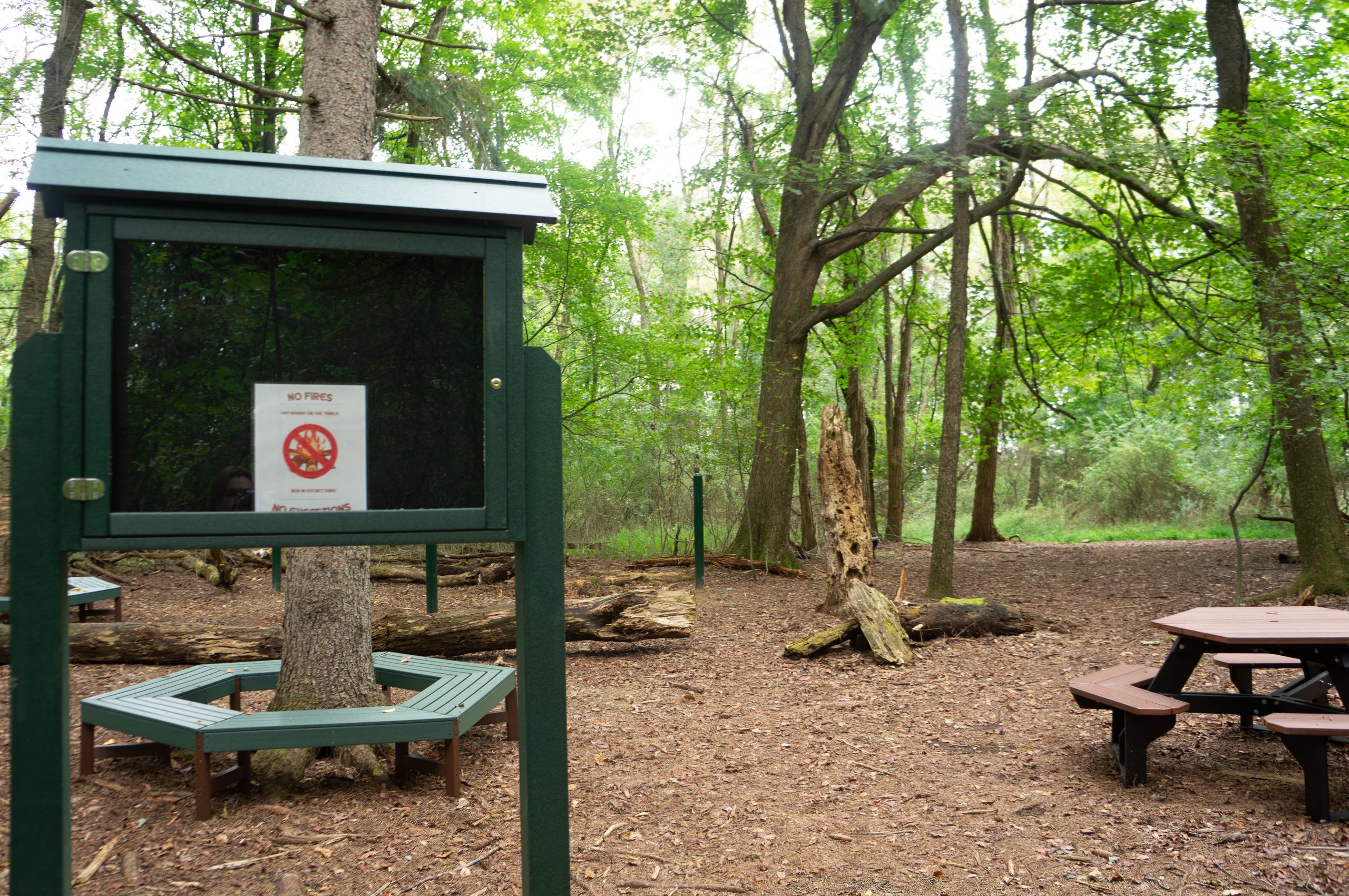
Slippery Rock University Honors College was awarded a $15,144 Green Fund Grant for the construction of a new ecotherapy trail and pocket park handled under a new sustainability sub-committee, and started by Honors College Director Jennifer Wilford.
The pocket park is located by the Art Sculpture Building with an entrance at the end of the resident parking lot. Across from the park is an entrance to the trail system. It stretches behind Smith Student Center, with another entrance located on the stairs between the Art Sculpture Building and Rhoads Hall.
Environmental science junior Alyssa Starkey, and hospitality and tourism management senior Mary Houk, were elected as co-chairs for the new suitability subcommittee. Both co-chairs sat down with Rocket reporters to discuss the project and upcoming plans for the space.
Co-Chair Starkey began with providing some background of how Jennifer Wilford conceptualized the project,
“It started when Dr. [Jennifer] Wilford, told us a story of when they were on their study abroad trip last year, some student came up to her and said, ‘Hey, we have a really cool way to incorporate ecotherapy into our university. So there were our grant writers,” Starkey said.
The Green Fund Grant is provided by Slippery Rock University and can grant up to $20,000. The grant is designed to support approved sustainable projects, educational programs and activities that promote sustainability. The grant is available to all SRU staff and full-time students. Student projects must be advised by faculty. The grant is competitive and judged by Green Fund Advisory Board, a board of students and faculty.
Previous Green Fund Grant winners include Dallas Scott, Slippery Rock assistant director of Campus Services. Scott implemented two new initiatives in 2022-2023, one focusing on the replacement of gasoline tools used by campus maintenance with lithium ion tools, as well as planting 15 new trees on SRU’s campus.
Starkey elaborated on when their involvement began in the project, coming on after the grant was accepted.
“Once we actually had the money and they knew that this project was actually happening, they decided to add two chair positions to the Honors College,” they said. “Within that role, we’re responsible for maintaining that ecotherapy trail and pocket park, the upkeep of the trail, the advertising around it and making sure that space is being utilized properly.”
While currently only the main trail is ready for use, Houk explained the Honors College’s aspirations to extend the ecotherapy trail project.
“There’s a secondary trail behind the water tower. We hope to be able to expand over there a little bit, but right now we are focused on the left side of the trail”
Houk elaborates on the set-up of the trail, and how it emphasizes ecotherapy practices and exercises.
“The equipment back there really leans into the natural space already,” she said. “There are benches that run around trees, there’s hammock posts, and then along the trail there is going to be signs with the actual exercises on them.”
Ecotherapy exercises will be displayed on signs following the trail and will change semesterly. Houk provided some information on what some of these ecotherapy exercises will include.
“Off the top of my head, grounding exercises. Four things you can see, four things you can smell…really encouraging people to stop and look around, activate all of their senses,” Houk said. “For this semester, a lot of what I found is rooted in forest bathing, which is a Japanese ecotherapy technique.”
Ecotherapy is a category of therapeutic practices that uses connection with nature to support mental health and control stress. Ecotherapy, specifically forest bathing, has actually been studied at Slippery Rock University. In 2018, Wilford worked with the Macoskey Center to study how time in nature affects one’s working memory.
Participants in the study were given a series of numbers that they were asked to recall after taking a 10 minute survey. Participants then repeated this process, but one group was given 10 minutes outside in an ecotherapy garden.
The ecotherapy garden is still open at SRU’s Macoskey Center, located behind the chicken coops.
Starkey provided a preview of what some of the pocket park and ecotherapy trial’s programming will look like.
“We will have six events total. We have about two events a week until the week before Homecoming,” Starkey explained. “All of those events, we will take back people back the trail and have various activities happening. We’ll have yoga, a trial mix bar, a read in the trees event, journaling, all activities that really immerse you in the natural environment back there.”
Starkey concluded by providing some of their own opinions on why a personal connection to nature is important.
“We are really into the belief that it’s important to have a natural place to disconnect, [and] to be able to have that hands on sensory experience,” they said.
Houk added, “I really like how the trail enhances what’s already back there for students who enjoy. And for those who aren’t hiking, or its not necessarily their area of expertise, it gives them an excuse to go and explore. Reap the benefits that maybe they wouldn’t have otherwise searched for.”