

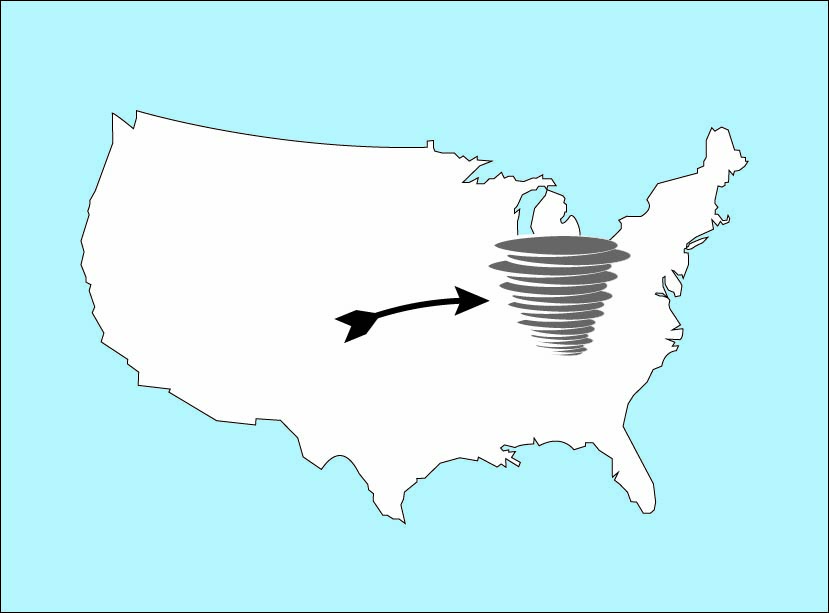
Bipolar temperatures, insanely fast winds and weekly thunderstorms have become the expectation for Slippery Rock’s residents, especially in spring. However, the first months of 2026 have stood out as especially terrible. Evermore frequent thunderstorms and heavier winds in Slippery Rock aren’t a coincidence, but rather part of larger trend of global warming and a full shift of tornado alley.
The Tornado Alley Shift
According to a study published by Journal of Applied Meteorology and Climatology, the United States’s “tornado alley” has begun to shift. Authors Timothy Coleman, Richard Thompson and Gregory Forbes explain that tornado patterns have slowly been moving eastward, with parts of the eastern U.S. now facing the largest threat for tornadoes. Additionally, they noted a seasonal shift in tornados, moving away from the “warm season” and “cold season.”
Tornado Path, a tornado tracking website and weather aggregate, highlighted a 34% increase in tornadoes within the Midwest from the late 20th century to the 21st century. The Midwest, including Ohio and Michigan, are ranked the 2nd highest among tornados, right under traditional tornado alley.
Tornado Path also notes that detection capabilities have improved drastically. This allows meteorologists to detect smaller tornados more effectively, potentially leading to a high number of tornado sightings.
The shift moves eastern Pennsylvania, Pittsburgh, western Ohio and our hometown Slippery Rock right on the edge of “tornado alley.” As time passes, we only move closer to the very heart of “tornado alley.”
Over the past twenty years, the National Weather Service of Pittsburgh data has shown an increase in tornados in Pittsburgh and surrounding counties.
This shift encompasses more than just tornado touchdowns but tornado conditions, faster winds, frequent thunderstorms and heavy rain or hail. This is contributing to recent thunderstorm patterns in Slippery Rock and surrounding areas.
Unexpected Consequences and Solutions
Severe weather, while often undiscussed, is a major pain point for U.S. citizens. Severe weather often disrupts access to power, water or transportation. One of the most filed insurance claims, The National Weather Service (NWS) found that weather events cost Pennsylvania $57 million in 2024. While constantly evolving technology gives meteorologists the best opportunity to inform the public of severe weather events, they still pose a serious threat. In the U.S., the NWS found that severe weather caused 1,084 fatalities.
The authors provided some insight into what might be causing a potential shift. Gradually-increasing temperatures may make conditions less favorable for tornados during spring. Additional melting of Arctic Sea ice affects atmospheric circulation impacting the jet stream. The authors also note that the shift may be caused by Pacific or Atlantic oscillation, the fluctuation of atmospheric pressure above the ocean, which we may see reverse itself in time.