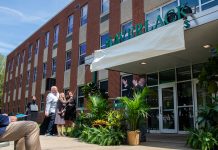
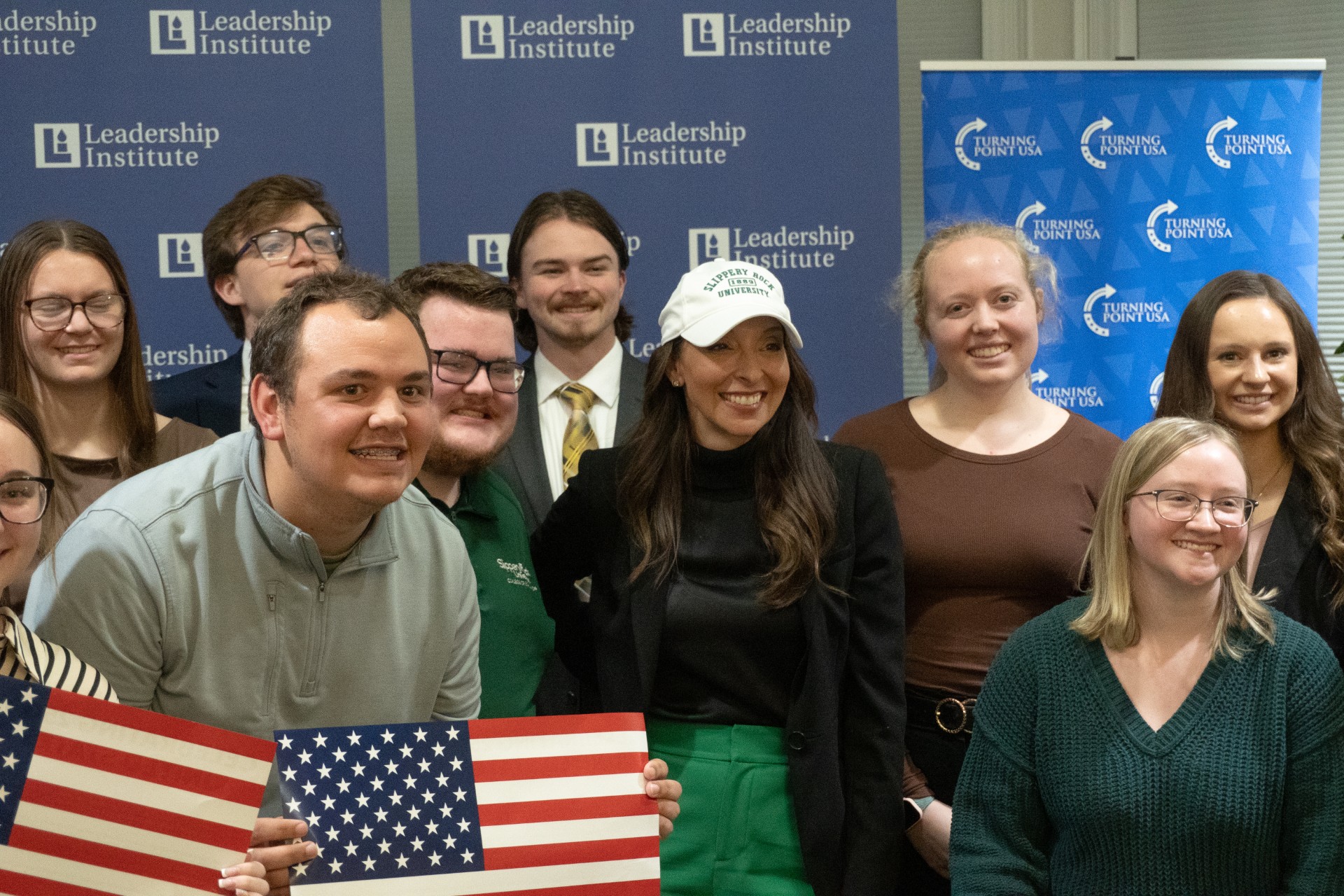
Erika Donalds joined Slippery Rock University’s Turning Point USA (TPUSA) at the Russell Wright Alumni House for a public speaker event on Thursday. Donalds is the wife of Florida representative Byron Donalds and a conservative activist for school choice. At Alumni House, Donalds discussed school choice, a free-market school model, and the abolishment of the Department of Education.
Donalds’s Background
Donalds began by explaining her background in finance and how her negative experiences as parent inspired her to shift into the education field.
“We have three boys. I think we only had two at the time, and my first son had gone to [public] school, and he did great. We patted ourselves on the backs, like ‘oh we’re doing wonderful as parents, we picked this great school,’” she said. “Then, my second son went to school and it was a miserable experience, he was crying every day. I was meeting with the teacher, the counselor, the assistant principal, the principal, and ultimately, they basically threw their hands up and said there’s nothing more we can do for him.”
Donalds details the lack of options the school provided: either medicating her son Darren or sending him to a designated classroom.
“If you’re not going to medicate him, we’re going to put him in a special classroom” Donalds recounts. “And not a special classroom here in this school, right down the street from your house. You’re going to drop your boys off in the morning and we will put the older son in class, and the other on a bus to go across town to be in that special classroom.”
Ultimately, her son Darren found success when the Donaldses enrolled him in a small, private Christian academy. Currently, he is enrolled at Truman State University, majoring in history and pre-law. While they found success, this motivated Erika to speak out for other families in similar situations.
“I thought, ‘how many other Darrens are out there, whose moms are listening to the experts and putting them on medication?'” Donalds said. “Or they don’t have any other option but traditional public school, and so they end up in an environment where they hate learning…I couldn’t imagine what our lives would be life…I thought, I had to do something about this.”
Donalds joined a volunteer effort with local families to start a charter school, affiliated with Hillsdale College in her community. When it started in 2014, they achieved 400 enrolled families with another 400 waitlisted.
“So, there was a huge demand in my community, where we had the best schools in the state, for an alternative to public schools. So I made the questionable life decision to run for school board,” Donalds said. “At this time, I’m still working in finance and I have a great career…But, I knew I couldn’t let this go. I served, I won against a longtime incumbent with the help of a lot of parents from the school; I helped start and served on the school board for 4 years.”
Non-Profit Experience
After Donalds’s time on school board, she and her husband started The Educational Freedom Foundation, a non-profit organization focused on school choice.
“The most impactful thing I’ve done is start that charter school. We were hearing from families all the time about how transformational it was for their kids, for their families,” Donalds said. “Their kids’ needs were getting met, they were getting great education…I’d rather make a big impact for a small number of people than make virtually no impact on a large number of people.”
Donalds went on to explain her nonprofit’s efforts in Florida, opening 6 different charter schools across the state. During the COVID-19 pandemic, Donalds created a fully-online virtual academy. Now Optimum Academy thrived after COVID-19 and is now the world’s first virtual reality school.
“Again, I keep hearing from families looking for options. We have one solution with classical charter schools or the online school. They find one that fits, and I love reading the reviews and end of year survey results. Because I know that feeling; I know what it’s like to be a mom desperate for something else for their kids.”
State Level and Department of Education
After success with her nonprofit, Donalds began working on school choice and charter policy at the state level.
“If any of you have been involved in or around charter schools, you know it is very difficult. There is a lot of opposition, even with the most friendly states like Florida, you still get a lot of pushback.” Donalds said, “I worked at the state level in Florida to help improve our polices, and then other states come calling and say, ‘hey, can you help us better our school choice policies as well?’”
At the start of the second Trump administration, Erika Donalds was asked to join American First Policy Institute, a research institute. Here, she has been working alongside Secretary of Education, Linda McMahon, to dismantle the Department of Education.
Donalds recounts her first negative experience with the Department of Education as a parents. The issue arose with Common Core, or the Common Core State Standards Initiative. An initiative started to increase consistency in high school education.
“I talked to my son’s teacher about [Common Core] and in the meeting, she started crying. She says, ‘I don’t know why they are doing it that way, I don’t like it either and I wasn’t trained properly.’ So I went to the principal, who said he had no control over that. I went to the district and they say it’s all state material…I met with the legislator and she said, ‘well no, it’s the federal government. The federal government gives us this money, and in order to get it we have to use the materials.’”
Donalds explained her opinion on the Department of Education’s funding philosophy. “What I learned both on my time working in policy and on school board, is that the Federal Department of Education uses a carrot and stick approach. And they are a power base for teachers’ unions, other left wing ideologies and nonprofits, to basically push down the things they want to happen in schools from the federal level using, most of the time, funding as the carrot, and the stick is, ‘we will take that funding away.’”
Donalds proceeds to explain what will happen to tasks handled by the Department of Education after its dismantling. Title 1 funds for low income and IDA funds for special needs students will potentially be handed over to Health and Human Services.
“How does it cost 47 cents on the dollar to comply with federal mandates? Well, let’s say I was a student with special needs, and they require certain services in the classroom,” Donalds said. “While someone is providing those services, working directly with the child, making sure they get what they need…The teacher has to document that, and the teachers documenting time costs money. This must be sent to someone at the school level, a special ed coordinator…then their report goes to the district where multiple people have to check boxes…I don’t think we need all of them. Certainly not with technology.”
Free Market Education
Donalds cites declining and stagnant test scores over the past 40 years as evidence of the Department of Education’s incompetence. She criticizes how schools will continue to get money despite performance.
“The public school system, what I call the monopoly system, continues to get money, regardless of their performance,” Donalds said. “When they underperform or they fail, they get more money. It is completely backwards and un-American. What I advocate for is education freedom and free market in education.”
Donalds compares this system to that of the current higher education system. Donalds said, “The consumer selects the institution. The institution does not select the consumer.”
Donalds concludes with discussion on the progress that has been made in the federal, specifically federal tax credit, programs.
“We now have 18 states in the United States that have universal school choice eligibility, not yet funding. Over half of the students in this country are eligible for school choice,” she said. “And now we have a federal tax credit program that was passed in the one ‘Big Beautiful Bill’ that, God-willing, will be available next year in Pennsylvania as well if your governor opts in.”
In a press interview with Rocket staff, Donalds expanded on Pennsylvania’s status on school choice.
“Governor Shapiro actually has a mixed record, [he’s] more school-choice-friendly than most democrat governors. He’s kind of gone back and forth, but we’re hoping he’ll opt into the federal tax credit and be the second democrat governor to do so,” Donalds said. “Pennsylvania actually has a decent record of school choice for a democrat-led state…So I think when you have states that are on that line that do exhibit some precedency to school choice, I think it really helps the argument across the country. I don’t think this should be a partisan issue.”
According to Donalds, this tax credit program would offer “private accounts [and] private donations that parents can use for private school tuition, homeschool expense, online courses, other curriculum, tutoring, special needs services, et cetera,” Donalds said. “It doesn’t matter if it’s democrats, republicans, independent; school choice is popular in the general electorate, over 70%.”
College of Education Response
In an email communication with Rocket staff, Keith Dils, the Dean of the College of Education responded to recent policy changes at the federal and state level.
When asked about how these polices affected our College of Education, Dils replied with, “Recent policy shifts at both the state and federal levels have created a more complex landscape for educator preparation. These include evolving certification requirements, increased accountability expectations and funding uncertainties tied to enrollment and workforce priorities. One of the biggest challenges is balancing compliance with these requirements while maintaining flexibility to meet the needs of students and school partners.”
In the midst of navigating these changes, the education department has undergone multiple shifts in curriculum and paths.
“In response to both policy changes and workforce needs, we have continued to adapt our programs,” Dils said. “This includes expanding alternative pathways into teaching—particularly for career changers and paraprofessionals—while also strengthening clinical experiences and partnerships with school districts. The goal is not simply to change programs, but to make them more responsive and accessible.”
To make these necessary shifts possible, the department received a grant of $600,000 from the Department of Labor.
Dils addressed the support that the department needed and what stakeholders make an impact.
Finally, Dils concluded by discussing where he sees the department heading in coming years.
“Support can come from multiple areas: sustained public investment in educator preparation, strong partnerships with local school districts and policies that reduce barriers to entering the profession, such as financial support for student teaching,” Dils said. “Additionally, recognizing and valuing the teaching profession more broadly plays a significant role in attracting and retaining candidates.”