

Slippery Rock University’s free-speech policies have prompted debate among students following concerns about a man who frequents the 9/11 memorial with signs displaying political and religious messages, including one that reads, “Homo-sex is a threat to national security.”
Free-Speech Policies
Vice president of Student Affairs, David Wilmes, said that, as a public institution, the university must protect freedom of speech.
“Individuals, both students and faculty and staff, community members of SRU, as well as people external to our university, are allowed to express their beliefs and positions and opinions publicly per the First Amendment,” Wilmes said.
Wilmes said that the university can place some restrictions on where, when and how speakers can interact on campus. SRU has three public forums, which students commonly call “free-speech zones.”
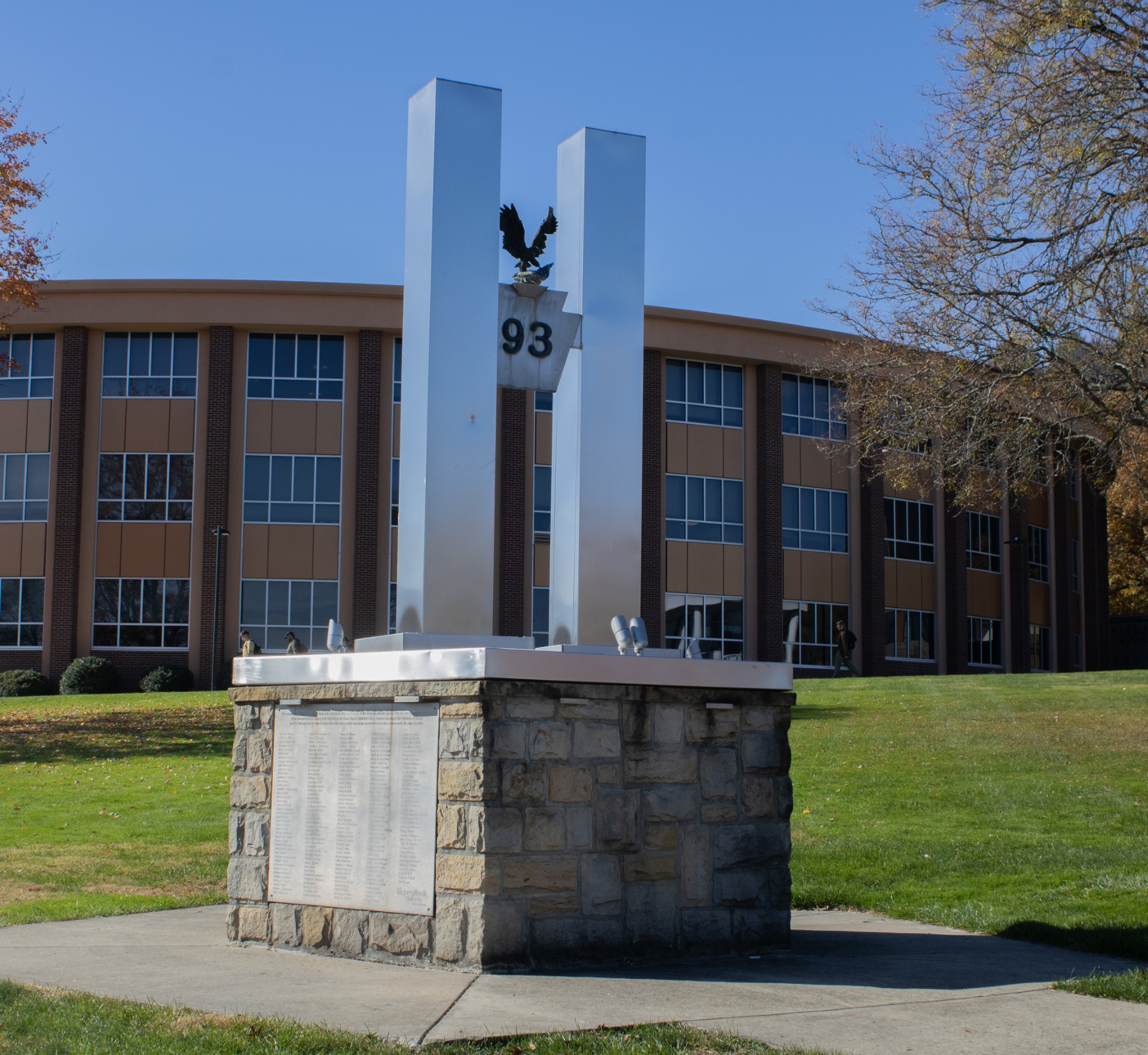
The designated areas are the lawn between North Hall and Old Main, the block “S circle” between Patterson Hall and Weissenfluh Dining Hall and an area off Campus Loop Road near the 9/11 Memorial.
Wilmes said that the areas were chosen to attract sufficient foot traffic without interfering with university operations.
“We chose places that were publicly accessible and, on the flip side, places that were not directly connected to the primary operations of the university… so we wouldn’t want to be distracting away from classes,” Wilmes said.
Harassment Concerns
Wilmes said students have raised concerns about whether the man’s behavior constitutes harassment. Although he understands their concerns, he said the man’s actions do not meet the legal threshold for harassment.
“I don’t want to be called names either when I’m walking across campus, but the First Amendment in the United States is very broad and allows for that,” Wilmes said. “Specifically, in terms of the Pennsylvania Code for Harassment, it wouldn’t rise to that level at all. And that’s the hard part.”
Charlie Stoops, vice president of the College Progressives Club, agreed that the man has a right to free speech but believes the man intentionally disrupts students’ routines.
“He is, I believe personally, a disruption. He goes out of his way, stretching the limits to target and harass students,” Stoops said. “He will go when there’s the long line at Boozel, and he will go out of his way to make sure he’s capturing a big enough audience as possible.”
Stoops added that some of the man’s comments could be interpreted as harassment.
“I think the man with the sign has sometimes told students or argued with students, ‘You’re sinning, you’re going to hell,’” Stoops said. “I think that could potentially constitute harassment. You could see that as threats, or if he were to make more explicit threats.”
Meghann Macklin, public relations chair of the College Progressives, said she has observed groups such as Abolitionists Rising, which is not affiliated with the university, standing outside the designated public forums.
“They’re on the sidewalk, not necessarily exactly in the area of where they’re supposed to be in the free-speech zone. And I know myself and other students will just avoid that area,” Macklin said.
ERA Advocates President Ariella Westreich said that, while she supports SRU’s free-speech policies, she worries about the effect that some speakers may have on students.
“While I respect SRU’s free-speech policies, I think it’s really harmful when a person or organization spreads hate speech, especially under the guise of free speech,” Westreich said. “…I don’t think it creates an open or healthy dialogue. It’s just kind of spreading bigotry and hate.”
Luke Elverson, secretary of SRU’s Turning Point USA chapter, said the group wants students to feel safe on campus but does not believe that should come at the expense of free speech.
“We want our students to feel safe and protected, but we have to give free speech a platform on campus, and we can’t change freedom because someone disagrees with a man yelling with a sign in peace,” Elverson said.
Elverson said that, though he has not seen anything he would consider non-constitutional, students with concerns should speak to the SGA or university administrators.
“I think if students are this concerned about it, obviously there’s a chain of command and how you get those decisions made is going to be a long process,” Elverson said. “I think absolutely bring it up at SGA meetings, bring it up to the right people to talk about it.”
Wilmes encouraged students who believe they have been harassed to contact University Police.
“Students always have the ability to go to the University Police and file a report if they feel like they have been harassed or victimized in some kind of way. Whether a law has been broken would have to be determined by the police,” Wilmes said.
However, College Progressives president Ryan Wajert questioned whether University Police are sufficiently familiar with the policies to help students who come to them with concerns.
“He did not know where the free-speech zones were. And then he was on his phone for two to three minutes, maybe longer, trying to figure out where the zones were, trying to find the policy on his phone,” Wajert said. “It seemed he didn’t have education on what the policy was, and he didn’t know what he was doing. So, I don’t have good faith that University Police would be of much help.”
Wilmes said he supports both the First Amendment and students’ right to avoid messages they do not wish to hear.
“Our students have rights just as much as these external people have rights, and so I think it’s important for them to understand that,” Wilmes said. “And if someone is really bothered by it, there is the opportunity to take a different route and stay away from the areas that are designated for the public forums.”
Disagreement
Wajert said that although he dislikes the man’s presence on campus, protecting free speech at a public university is important.
“I think it’s terribly unfortunate that the sign guy’s present on campus. I find his words and his actions reprehensible. I know he makes a lot of students on campus feel unsafe and uncomfortable,” Wajert said. “…I think enshrining free speech and allowing the public to come onto state campuses and places where their tax dollars are being used and allowing expression on campus, however, is very important.”
Kit Traum, treasurer of the College Progressives, echoed Wajert’s statement.
“The sign guy and Turning Point have brought views onto this campus that are very questionable,” Traum said. “However, on principle, everybody must be committed to free speech. It’s one of the greatest values that this country was founded upon, and it’s something that we need to protect.”
Wajert said determining the limits of protected speech is difficult.
“‘Where do you draw the line on non-protected speech?’ is famously incredibly hard to come down on,” Wajert said. “I don’t know that what he does constitutes harassment.”
Stoops said the absence of a constitutional category of unprotected hate speech complicates the issue.
“It’s worth noting that hate speech isn’t really a thing in the U.S. Constitution like it is in other constitutions. Maybe it should be. I think that’s a whole separate debate,” Stoops said. “But as it stands, it isn’t, which makes the line a lot blurrier.”
Chase Schiffhauer, vice president of SRU’s TPUSA chapter, said that the university should only limit free speech if a speaker incites violence.
“I see no reason why the university should be limiting speech unless he was calling to action for violence or spreading, you, know, hateful messages can be interpreted in a certain way, but as long as its remaining respectful and peaceful, I see no problem with it,” Schiffhauer said.
Elverson added that a speaker’s conduct could become an issue if it disrupts students’ abilities to go about their lives on campus.
“If it’s too much, over the top, if it is affecting the students and how they are able to conduct themselves, that can be seen as an issue, even a threat potentially,” Elverson said. “But overall, I think it’s free speech, so he has the right to do it. If you don’t agree with it, that’s tough, but it’s free speech.”
Schiffhauer emphasized that supporting the man’s right to free speech does not mean TPUSA endorses everything he says.
“We as a Turning Point chapter, we don’t condone all the things he’s saying. I don’t even know all the things he’s saying to be honest. We just want to make that abundantly clear,” Schiffhauer said. “We are in support of the First Amendment. We believe we’re all given that God-given right. We just want to make that clear as well, though.”
The man declined a request for an interview.
Communication of Policies
Wilmes said he hopes greater awareness of the university’s free-speech policies will address some students’ concerns. The university has placed signs with QR codes linking to its policies near public forums and an SGA committee created a video explaining the policies.
“We had had some initial conversations about ‘How can we better spread the word around that?’” Wilmes said. “The idea was to work together to try to get the word out so that people understood what the policy was.”
Wajert said he believes the university’s communication about its policies remains inadequate.
“I think the biggest gap in their handling is that they do not communicate very well what is not allowed, their policies,” Wajert said. “…There’s a lot of students that feel incredibly uncomfortable by his presence, that feel personally threatened. It really gets to them and their identity. And I think the university needs to do a much better job publicly communicating where the bounds are.
Stoops said LGBTQ+ students deserve clarity about the policies.
“Slippery Rock is a vibrant queer community with queer students who I think deserve to have this clarified for them,” Stoops said.
Macklin said the university has a responsibility to explain how public forums work and what rights students and outside speakers have.
“With having these public spaces, it’s the responsibility of the university to be open and honest with students about how they function and like, and what rights the students have and what rights outsiders have,” Macklin said.