
By Annabelle Chipps
Tri-County Landfill (TCL) in Grove City, PA received a permit to reopen after closing in 1990.
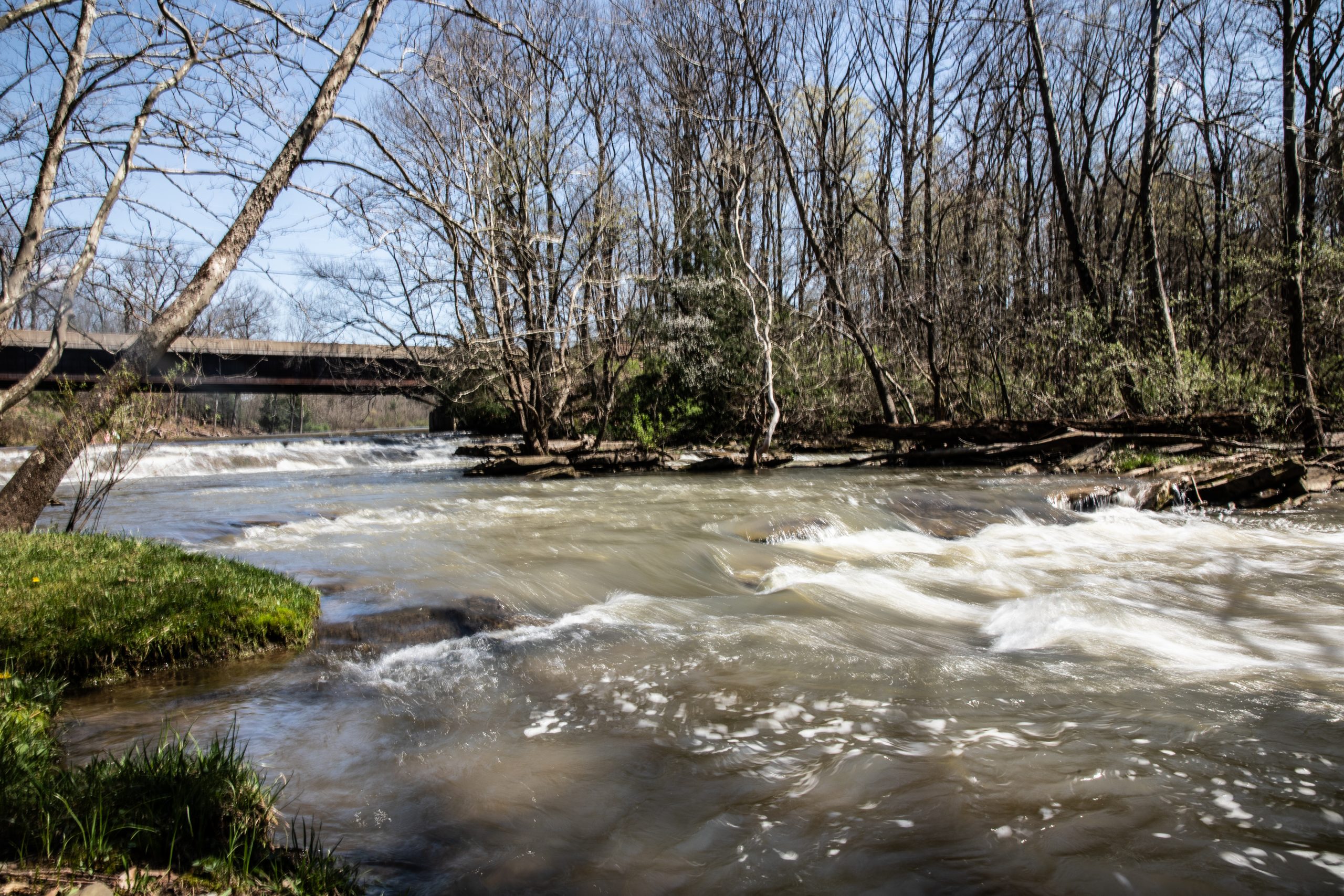
This Waste Permit will allow them to store radioactive waste, which would flow from Black Run into Wolf Creek, then into Slippery Rock Creek. This could directly affect the health of Slippery Rock’s environment and citizens, according to the Citizen’s Environmental Association of the Slippery Rock Area (CEASRA).
The landfill is owned and operated by Vogel Disposal Service, Inc., who claims their company complies with all government regulations.
Science at the landfill level
The process begins when a leftover fracking material called brine is brought to a landfill. Much of this brine contains the element radium 226 (Ra-226), which is common underneath Pennsylvania, according to NPR.
In fact, companies waited years to begin fracking in this part of the country because it has such high radioactivity, according to environmental reporter Justin Nobel.
When it rains over the brine in the landfills, a liquid called leachate forms and is collected before being dumped in a nearby creek. This process is standard for any waste facility.
According to the Environmental Protection Agency (EPA), waste is considered radioactive when it reaches the level of 60 picocuries of Ra-226 per liter (pCi/L). This is twelve times the amount of radium considered safe to drink, and the same amount the Nuclear Regulatory Commission allows to be dumped in streams.
Leachate cannot be treated out of water. The radium in the water will last 1,600 years before decaying into another element.
Seneca Landfill
Vogel Holdings Inc., or Vogel Disposal Service Inc., is one of the largest waste management facilities in Pennsylvania. They own TCL in addition to Seneca Landfill, where all of SRU’s garbage ends up, and several other sites.
According to a 2016 study by the Department of Environmental Protection (DEP), Seneca Landfill is the 9th most radioactive landfill in the state. Its average radium content in leachate is 112 pCi/L, nearly double what is considered radioactive.
The report documents that Vogel is permitted to dispose of this leachate in the Connoquenessing Creek.
However, the location’s website claims they do not accept radioactive materials.
Tri-county Landfill
TCL first opened in the 1950s, before it was purchased by Vogel Holdings in 1975.
“Natural accumulating soils, back then, was what was permitted,” Edward R. Vogel, the founder’s son, said. “The regulations changed in ‘88 that any landfill, there was over 1,200 in PA at the time, they all had to go through a re-permit…the state went from over 1,200 to less than 50 landfills by April 1990.”
This change in policy caused TCL to close down originally.
“It was definitely a learning experience for everybody,” Vogel said. They have been trying to reopen the site ever since.
According to a Pittsburgh branch of NPR, Vogel Holdings’ permit was denied 26 times.
“There are some different changes that were made after that major rule changing that tweaked it even more…it just wasn’t that easy for everybody…there was a lot of people that tried and there was a lot of people that couldn’t get the approvals,” Vogel said.
The landfill still stood in Grove City, but was unable to be used.
“My whole thing was—there’s trash there—I’ve always wanted to try and do the right thing to dig up the old landfill, relocate it and put it on the double composite liner that exceeds what the current regulations are, and it’s taken me 30 years to get that approved,” he said.
“Personally, I think some of [the rule changes] might’ve been done to make sure we didn’t get it. I can’t say that for sure…you really gotta wonder sometimes that maybe there was more politics than anything else involved.”
Vogel was asked why he believes people oppose the reopening of the landfill.
“They would oppose, I think, any landfill…and that happens. There’s some people like that, they don’t fully understand everything. They make accusations that aren’t necessarily true and other people listen. They don’t know, they don’t understand.”
He said most claims made about fracking waste are “all BS. We have radiation monitors. You can’t exceed a certain limit.”
He was then asked if there would be fracking waste in TCL, to which he replied, “No, well…There are some materials we will be able to take that could come from some of that. It won’t be the water, it’ll only be sludges, it would have to meet certain limits to be able to do it.”
Vogel then discussed how people are extra wary of radioactivity, even though it’s in most modern homes.
“I’m not so sure [that Seneca Landfill is one of the most radioactive in the state]. I disagree with that…There was something about one sample or something like that, so I’m not so sure that’s true because we never took that much material and I would have to see all that to verify,” he said.
Vogel mentioned that he has two on-site engineers to make sure all testing is in accordance with the law. However, CEASRA and others are concerned that the law doesn’t match what is scientifically safe.
“That depends on who’s trying to interpret it and how they wanna try and interpret it. You could put Aspirin in a glass of water and test it and say it’s polluted,” Vogel said. “People try to portray me as some evil person, and that’s not true. I put my pants on one leg at a time and put my shoes on one foot at a time, same as everybody else does.”
He claimed he is more than happy to share facts and figures with anyone who asks.
“I don’t feel that I have anything to hide,” he said.
Environmental Effects
Jane Cleary is CEASRA’s historian and legal liaison. She claimed the DEP permit would allow TCL to dump 85,000 gallons of radioactive leachate per day that would flow downstream to Slippery Rock.
If animals drink from the Slippery Rock Creek, the radium will enter their bodies, according to Cleary. It may also soak into the ground, where Slippery Rock’s water comes from.
She also said it could contaminate food grown near the creek or with water from the creek. Additionally, Ra-226 is airborne so those visiting the creek or living near it may also ingest the toxin.
“It takes a while for cancer to develop, but Ra-226 causes cancer…It’s definitely a cancer causing agent,” Cleary said.
Worst-case scenario, Slippery Rock could resemble Chernobyl or the Love Canal community where people will be forced to evacuate.
“It’s not something that can be easily corrected,” Cleary said. “I would venture to say nobody in Grove City nor in Slippery Rock is testing for Ra-226 in the water right now, and they won’t be testing for it until somebody says they want you to test for this.”
Allegedly, part of the reason permits for TCL were denied is its proximity to the Grove City Airport.
“Birds feed on the garbage, like potato peels, and fly up and hit the planes. There was a jet that did get damaged a year ago by just such a thing…the damage was over $1 million. The planes have to fly right over this landfill when they land at the Grove City Airport,” Cleary said.
CEASRA’s efforts
CEASRA hired a lawyer to make an appeal to the Environmental Hearing Board of Pennsylvania in 2023, but it was denied. The goal was to stop the landfill from reopening.
They will now be heading to the Commonwealth court along with another environmental group. If the appeal fails again, they will take the matter to the Supreme Court.
Most fundraising goes straight to legal fees.
“As I’ve been researching this topic, I understand that this is not unique to our community. There are about 45 landfills across the state…I realized that there’s a lot of radioactive places already,” Cleary said. “We’re trying to keep ours from being radioactive, but Butler County has one of the hottest landfills in the state and the owner of that is also the owner of this one they’re trying to open.”
Student involvement
If students oppose the reopening of TCL, there are several ways to get involved.
First, CEASRA always accepts donations to fund legal fees. While college students may not be able to donate themselves, they are welcome to hold fundraisers.
“Helping us put up signs, that’s a good thing,” Cleary said. The group also frequently needs students to pass out literature, such as pamphlets, at different events .
This fall, CEASRA will have a booth at VillageFest where students can help.
“We would love someone to have us come speak to any group [on campus], if there’s a group of students who would be interested in hearing more about this,” Cleary said. The group spoke at the Macoskey Center recently as part of Earth Month.
Those interested in learning more about CEASRA and how to get involved can visit their website at CEASRApa.com or email CEASRA@zoominternet.net.
SRU’s response
The Rocket reached out to SRU Communication with several questions regarding this situation.
The university replied with a written statement, claiming “matters of safety and environmental health [are] a top priority.”
“Through our Office of Environmental Health & Safety/Emergency Management, we monitor and assess all possible threats and implement prevention or response protocols as necessary,” the statement said.
It is unclear whether the school has publicly addressed this issue in the past or provided resources on it. However, “For some potential threats, especially those beyond our campus, we rely on local and state environmental and emergency management agencies to ensure the most accurate and up-to-date information,” the statement noted.
The university also mentioned that all water is treated and tested by the Slippery Rock Municipal Authority (SRMA), and is currently safe to drink.
“If the university is made aware of any concerns, it will respond accordingly and communicate with students, faculty and staff,” the statement said. “In the unlikely event that SRMA could not meet the University’s needs, tankers of drinking water would be purchased to refill our water tank…to maintain the University’s water supply.”