
In March 2020, SRU students were sent home for spring break. However, the campus did not resume completely in-person instruction until fall 2021.
Now, it has been over five years since the world was seized by the COVID-19 pandemic. According to the World Health Organization (WHO), over 1 million Americans have passed away from the disease so far.
Though the pandemic has led to societal, political and financial change, some students and faculty at SRU believe the campus has almost returned to the way it was.
What was SRU like before the COVID-19 pandemic?
“One thing I can particularly speak to was, we had a very engaged campus when it came to campus events, you know, showing up to things, students keeping up with one another, big clubs and organizations and that sort of in-person experience,” Vice President of Student Affairs David Wilmes said.
From 2014-2019, SRU averaged 1,567 first year students each fall. During 2020-2022, this average decreased by 9%. However, it has only been up since then.
A 2023 SRU graduate, whose freshman year began in fall 2019, said the campus “always had something going on.”
Extended spring break?
“We had to kind of send out an announcement, basically saying, ‘Don’t come back right away, there’s this pandemic thing, and maybe it’ll be another couple of weeks,’ at the time,” Wilmes said. “We had no idea that we would send everyone home for good for the spring semester.”
He claimed the event was very “stressful and surprising for everyone, because we didn’t know what was going on.”
The school moved classes online until fall of the following year. However, this posed logistical issues for the university. Students living in residence halls had to schedule specific times to retrieve their items.
“We knew so little about it as a nation, so little about COVID at the time, “ Wilmes said. “That spring and summer was pretty much planning for the next year.”
During this time, all SRU vice presidents met with the president of the university three times a week.
Return to normalcy?
“SRU during [the pandemic] was awful,” recent graduate Kendal Campbell said. Her freshman year began fall 2020.
“Online science courses were so difficult, it was hard to get into office hours because of limited spots/time and the ability to make friends was almost nonexistent,” she said. “After COVID, the classes seemed to go back to normal and the ability to mingle went back to normal.”
Usually, 2,900 students live on SRU’s campus at a given time, according to Dr. Wilmes.
However, during the 2020-2021 academic year, only 850 students were living on campus.
“We basically told everyone who was a freshman that year, ‘We’re moving all the classes online, unless you have a reason to be in the residence hall, to live on campus because you don’t have a place to live, or you’re too far away…you should not come to campus…’”
When students tested positive for COVID that year, they were instructed to isolate for 10 days per the CDC.
“We were really worried about people, leaving them all alone in their dorm room by themselves…[Aramark] would deliver breakfast, lunch and dinner to those people who were isolating in their room…they gave them all their meals at once,” Wilmes said.
SRU also tried to do events and activities online via Zoom calls.
“That was a very different approach for us,” Wilmes said. “I mean, most of our classes are in person here at The Rock and the events we do, the whole point of that is to bring people together, right? So, we tried to do that virtually. It was not as successful as our intent.”
The university also published regular updates regarding the number of COVID cases on campus.
Masking up
“The next year, we knew we were going to be more open again for business,” Wilmes said.
2021-2022, SRU was open for campus visits and allowed people to live on campus with limits to the people living in four bedroom suits and regular testing.
“Those that lived on campus had to go to regularly be tested through the spit cup to be tested for COVID in order for us to track if we had any outbreaks or anything like that,” Wilmes said.
Senior Clementine Grossoehme commented on these tests.
“I remember the vile weekly spit testing and how awful the quarantine food was,” she said.
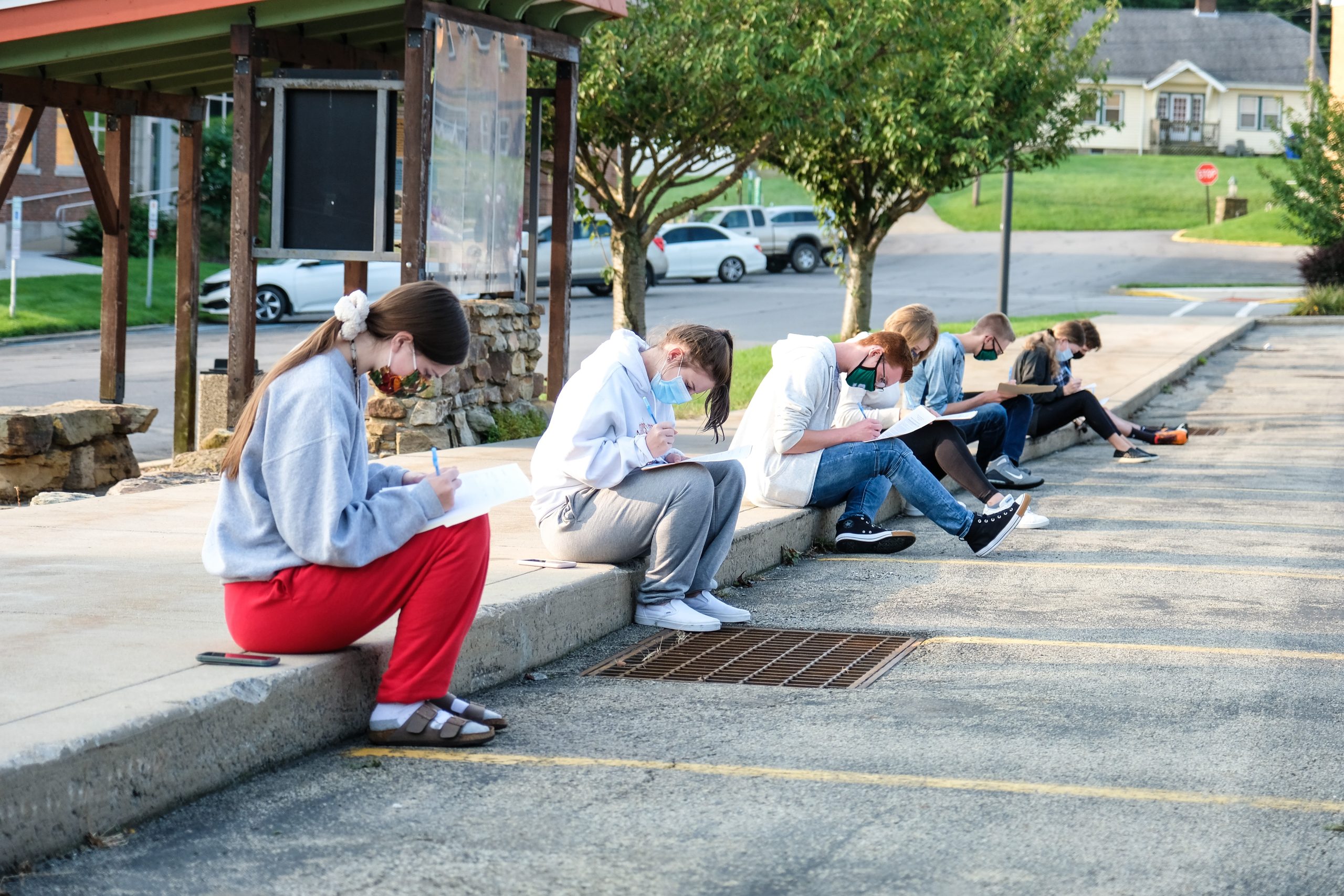
The campus also followed Pennsylvania law and remained fully masked until March 2022.
“A big part of that year was both in the residence halls and then in classrooms, was asking and making sure people wore their masks,” Wilmes said. “Some people didn’t want to wear masks, and that was just difficult, and then professors teaching in masks, sometimes people couldn’t hear.”
“There were a lot of challenges that happened with masks,” he said.
Offices also had plexiglass up to separate students from receptionists and ensure less germs would be spread.
Additionally, masks with helpful COVID-19 guidelines were posted around campus, as were social distancing stickers for places like Rocky’s where people had to wait in line. Some of the signs are still up today.
“After that really shut down year, we wanted to bring people back to campus, but we also wanted to be safe given the information we had at the time. The social distancing thing was a part of that, the mask thing was a part of that…There was a lot of things,” Wilmes said.
Because SRU could not require students to get a COVID vaccine as a PASSHE school, they began a “Rock the Shot” campaign in late 2021. This included raffles, flex money and a promise that if enough students were vaccinated by a certain date, then-president Behre would receive a student-designed tattoo in front of the entire student body.
“We knew, based on the science, it would be good for our community to have people vaccinated. Not force it, but encourage vaccination,” Wilmes said.
Students were reluctant to either get the COVID-19 vaccination or share their status with the university. The contest had very few entries, so the school decided not to continue the campaign.
“It was a flop,” Wilmes said. “It’s not a secret…it was not to the level we had hoped.”
The mask requirement was lifted and, eventually, WHO claimed the pandemic was over.
Five years later
Though 2020 is far away, the virus itself is not. COVID-19 appears to return each cold and flu season.
“I avoided COVID for four years until I came to Slippery Rock. I got it the second week I was here,” freshman Anabelle Tomlin said.
Guidelines now focus on symptoms, instead of testing. People usually leave quarantine if they are symptom-free for five days.
There is still some evidence of the pandemic at SRU.
Wilmes described a leadership gap within campus organizations, which is now closed. For a period of time, there were no students able to hold executive board positions because they didn’t have experience with clubs.
Though only 3% of classes are fully online, professors now have the opportunity to do online office hours or work remotely if needed. Other meetings and even campus speakers can be held on zoom as well.
“This academic year,” Wilmes said, “I think we’ve returned to the same level of vibrancy and involvement that we had pre-pandemic.”
“I remember talking about, what is it going to be like? Are we going to want in-person events? Are they going to be worried about being in large groups…the reality is that those things came back even stronger. I think for a lot of students, especially those that had COVID during high school, they were really wanting to be in-person and experience things first hand and live, not through a screen.”


