

This article was written by Jenna Lubinski, co-president of College Dress Relief
A similar version of this article will be published on CollegeDressRelief.net
The ability to dress in whatever way you please is a privilege that women in America and many other countries possess without often realizing it.
What we wear embodies personality, mood, characteristics, etc., especially when clothing takes the form of resistance and cultivating the femme experience that changes over time.
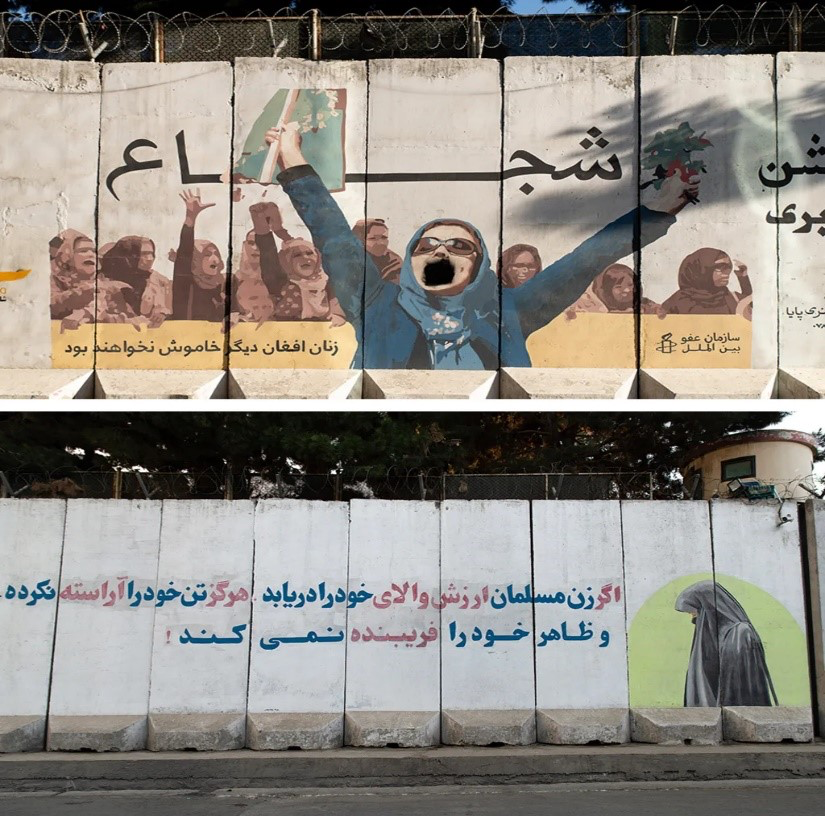
However, some women — specifically in Afghanistan — are legally and religiously banned from choosing what they want to wear. Law requires them to wear a burqa where their appearance is covered from head to toe, and their existence must be as discrete as their looks. These legal precedents give women no rights or autonomy.
However, this was not always the reality for women in Afghanistan.
History
The mid-20th century (1950s-1970s) was an era of vast cultural translation and modernization within Afghan fashion. European/American styles mixed with traditional Persian and Indian intricate designs, especially in cities where modernity was more accepted.
In rural areas, these fashion trends were encouraged, but body coverings such as the chador or purdah were still worn due to conservative values.
Throughout 1979 to 1989, the Soviet Union gained control of Afghanistan, causing a mass urbanization of fashion. European styles became significantly more common, and women were strongly encouraged within society to explore these trends.
However, the Taliban era (1996-2001) took away the opportunity for women to dress how they wanted and to incorporate different countries’ styles.
The Taliban is a militant group that enforces a strict interpretation of Islamic law. They are known for their oppressive rule, particularly towards women.
Therefore, the Burqa mandate was enacted. Women were forced by law to wear a full-body covering that hid women’s entire bodies. This included their faces, leaving only a small mesh screen for them to see through.
This became mandatory for all women in public, effectively eliminating any expression of personal style.
After the fall of the Taliban in 2001, Afghanistan experienced a brief period of cultural and political freedom, with fashion once again becoming more diverse.
Women regained the freedom to wear clothing such as skirts, dresses, pants and blouses, though many continued to wear traditional garments like the chador or headscarf. Modern styles such as jeans, t-shirts and high heels were adopted by young women, particularly in urban settings.
Clothing options for women became vast again and political and religious restrictions were not imposed.
In 2021, the Taliban returned to power and reversed many women’s rights and freedoms, including the ability to express themselves through clothing. The Burqa was heavily mandated, and bright colors and form-fitting attire were inexcusably prohibited.
Not only was clothing restricted, but the Taliban also issued decrees that limited women’s participation in the workforce and public life, further restricting their freedom to dress, live and breathe.
Reflection
I feel the Afghan women’s body, mind and soul are tormented and oppressed along with their autonomy.
One fascinating yet sad reality is that conversation pertaining to this topic rarely is discussed outside of this region because it is not a reality that we experience.
Thus, it is a privilege we have. However, it is also a privilege to ignore something when it doesn’t affect you. My thought process is that if it can happen somewhere else in the world, then it could easily happen within this country.
Hence, women’s rights and equality are ongoing issues presented in every country. The fight for equality is not just an individual struggle, but a collective one, where every victory strengthens the foundation for the next.
Overall, clothes are not items that we simply wear but are interwoven within our identity through stitches (characteristics) that make us who we are.
The restrictions placed on women’s clothing in Afghanistan are not just about fabric or style; they symbolize the erasure of freedom, agency and identity. What they wear — or are forbidden to wear — becomes an emblem of their silenced voices and restricted existence.
Clothing in this context becomes a battleground for identity, culture and the fight for basic human rights. Each piece of cloth serves as both a physical barrier and a psychological one, confining women to roles defined by rigid, patriarchal systems.
Taking action
There are several ways to help women escape oppressive patriarchal systems in Afghanistan.
First, continuously educate yourself on this topic to spark more knowledge and spread information.
Additionally, one should donate to charities, such as Women for Afghan Women or UNHCR, that provide direct aid to women in these areas.
Finally, go online and find petitions that align with this cause. Change.org is a great place to start.