

Content Warning: This article contains mentions of suicide, drugs and mental health struggles. Please proceed with caution.
Kevin Hines visited SRU on Feb. 5 to give a presentation on mental health and suicide prevention.
The event, titled The Power of a Second Chance, was held in the Smith Student Center Ballroom. Hines spoke from 7 p.m. to 8 p.m, then gave individuals the opportunity to ask questions.
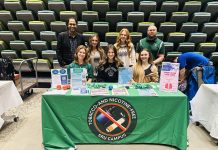
Student Support and the Counseling Center were also there to support students and advertise their services due to the sensitive subject matter.
Who is Kevin Hines?
At 19 years old, Hines attempted to take his own life by jumping off the Golden Gate Bridge in San Francisco, CA. He shattered several bones, but survived.
Hines is now a well-known mental health advocate and suicide prevention speaker.
He began his presentation by taking a moment of silence to honor those who have died by suicide or drugs.
“Let us honor their memories tonight. Let us hold them dear. Let us never, ever forget the light and the beauty that shined from within them when they were still here with us, and let us choose to hold immeasurable gratitude for the very little time we had with them,” Hines said.
The advocate then talked about his childhood, mental health struggles, suicide attempt and journey to mental wellness.
He discussed being born into poverty and neglect, then having to suffer the loss of his biological brother before finally being adopted into a loving family.
In infancy, he was not properly nourished, which had an effect on his brain.
“I was, by definition, mentally ill from the very beginning of my life,” Hines said.
His childhood was filled with happiness and safety for years after the Hines family adopted him.
“But even given this incredible chance at life, it would all come crumbling down because of one thing: my brain,” he said. “From 17 and a half years of age, I was diagnosed with bipolar depression, type I with psychotic features…But do you all think for one moment I was telling my family, my friends or my doctors what I was really going through? No, I buried it.”
He explained that after two years of hallucinations, euphoric highs, depressive lows and denial, the pain he experienced “became too much to bear.”
Hines wrote a note and told his father he loved him before boarding a bus to make a decision that would change his life.
“I’m on that bus crying like a child, hoping, wishing and praying that one person would see me and say something kind and stop me. But I couldn’t stop myself,” he said.
When Hines approached the edge of the bridge, nobody questioned him, leading him to believe nobody cared.
“The auditory hallucination in my head beckoned at decimals I cannot express to you without piercing eardrums, ‘Jump now,’ and I did,” he said. “The moment my hands left that rail and my legs cleared it, I had an instantaneous regret from my actions and the absolute recognition that I had just made the greatest mistake of my life.”
Hines claimed he prayed to god to survive, and later learned he was kept afloat by a sea lion until emergency responders saved him. 99.99% of those who jump off the bridge do not live, but he did.
“I’m grateful to simply exist. I get to be here,” he said. “I’m in a lot of pain every day, physically from what I did to myself off of that bridge 24 years ago, chronic physical pain…brain pain from living with bipolar depression…But I need no pity from those two types of pain. I caused the first one to myself, and I need to take responsibility for my actions.”
The advocate now dedicates his life to sharing his story and pushing for mental health reform in America. He still receives help himself whenever he needs it.
Hines had heard of SRU prior to his visit and shared his excitement for his presentation.
“I was really looking forward to this presentation, and my hope is that I deliver a presentation that inspires people to change their lives and to help prevent suicide and to help people live a more mentally healthy and well life,” he said.
What college students need to hear
Hines said his message is especially important for college students because they are “both at the forefront of education and helping to grow into adulthood.”
He claimed this demographic will “be faced with challenges and tasks that have to have a lot to do with their brain and mental health.”
“[It’s] one of the age groups that is closely related to suicide and to brain and mental challenges and struggles,” he said. “Addressing this audience is crucial, because these are the folks that are going to go out into the workforce and change other people’s lives, and if they’re well equipped to help people in brain pain, then they can do a lot more good in the world.”
He then shared specific ways college students can support themselves and others.
“Be honest with yourself. Don’t sit in denial when you’re struggling mentally. Be honest, be bold. Tell the truth about your pain…a pain shared can become a pain halved,” Hines said.
He urged students to help others if they see someone struggling, reminding them of the power in asking how someone is.
Lastly, he noted the importance of having a wellness routine and shared tips on getting through tough moments.
“If you are having thoughts of taking your life, of dying by suicide, I’m going to ask you to stop. Take a breath…in through your nose four seconds, holding for four seconds and releasing pursed lips like a whistle, but no sound, six to eight seconds. Do that literally 30 to 40 times,” he said. “Bring your brain and mind to a complete calm, relinquish the inner critical thoughts that are going on in your mind…Reach out, be honest about your pain and stay here. We need you.”
SRU Resources
The SRU Counseling Center provides free, confidential psychological services to all students.
Additionally, the Dean of Students office, which includes Wellness Education, Student Conduct, Personal Integrity, Student Support, Rock Pantry+ and Disability Services is “committed to the support and development of the whole person by improving students’ abilities to successfully manage challenges and creating an environment in which students are likely to thrive,” according to Rock PRSSA. Both services are available in the Campus Success Center.
For emergencies, contact 911 or university police at 724.738.3333. The Center for Community Resources, Inc. is also available at 800.292.3866.
If you or someone else is at immediate risk of suicide, please call the National Suicide Prevention Lifeline at 1.800.273.8255 or dial 988.