
Slippery Rock University’s Turning Point USA chapter hosted a speaking event featuring activist Chloe Cole on Oct. 16 in the McKay Education Building.
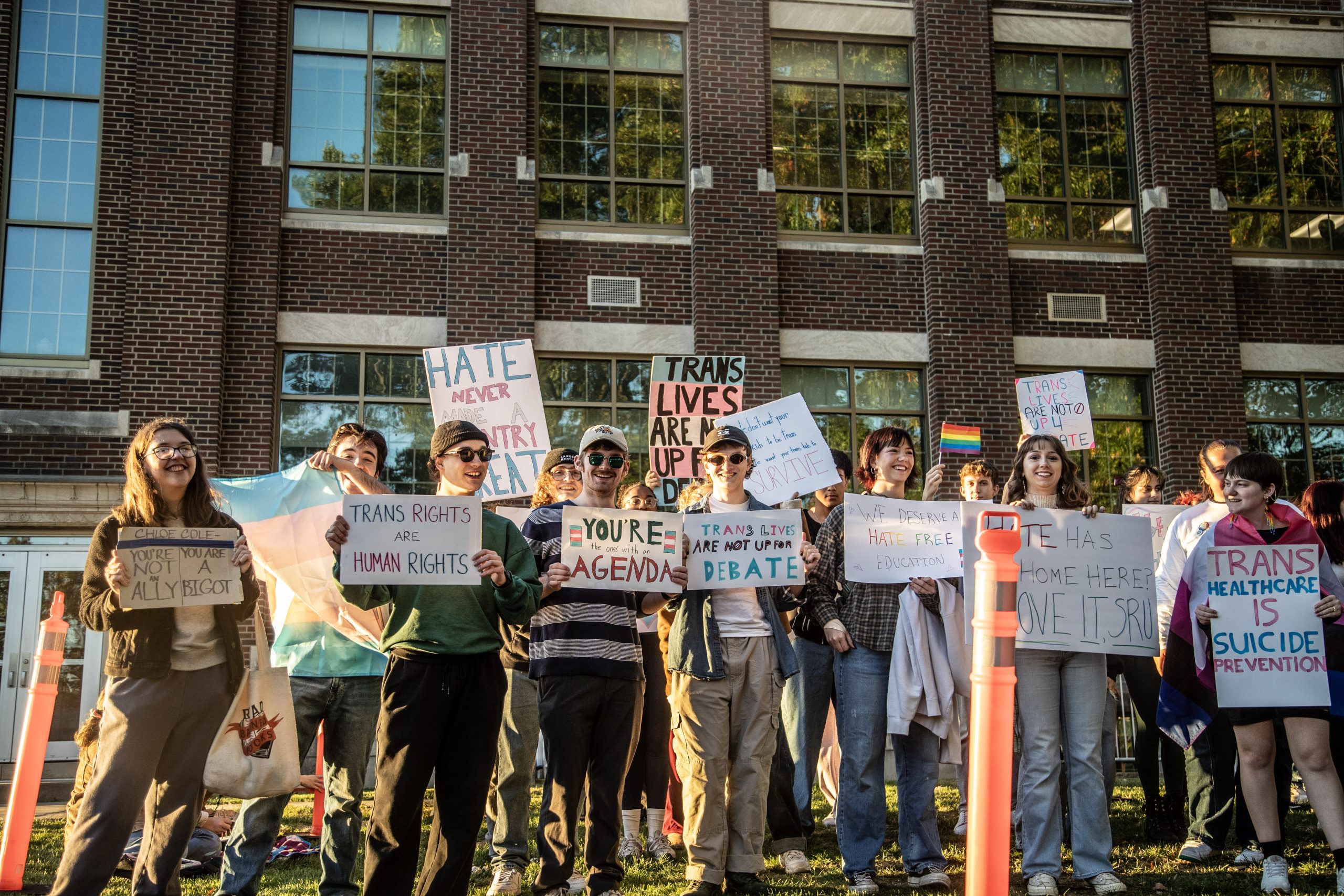
At the same time, outside the building, a group of SRU students gathered to protest the event centered around Cole, who is known for her opposition to gender-affirming medical care for minors.
Alex Thompson, the president of Slippery Rock’s Turning Point USA chapter, first heard of Cole at Turning Point USA’s annual America Fest in Dec. 2024.
“We got to meet her and listen to her story for the first time. That’s what inspired us to want to bring her to campus,” Thompson said.
The event involved an introduction of Cole followed by sharing her story of transitioning at the age of 12 before detransitioning at 17. Cole’s story was followed by a question-and-answer portion where both students and general admission could ask Cole questions.
“I’m really grateful to you, the Turning Point chapter of Slippery Rock, for pulling this all together and to Turning Point as a whole, because I have been working with them as a speaker for, I’d say about two and a half years now, and throughout the years, they have been incredible organizations to work with,” Cole said during the event.
The activist then went on to share how quickly her life changed as she adjusted to life as a prominent political figure.
“Both in the larger events and with every chapter, it’s just been such a wonderful journey. And to those of you who are students here, but are not already a part of the chapter: I sincerely encourage each and every single one of you to get involved. And everybody in this room, I thank you all for having me at your school, for coming to listen, to learn and to exchange ideas,” Cole said.
She shared that she got to travel internationally last year, visiting multiple countries. Cole also spoke to the human rights committee at the United Nations in Geneva, about gender ideology and “the importance of protecting the civil rights of children and parents and families.”
“[I was] the kid who spent most of her time drawing or withdrawing. But what I didn’t expect was that I would go from sitting in the classroom to sitting in on legislative hearings, caucus meetings and lobbying conferences, which actually has been a lot more fun than it might sound. But more importantly, it’s brought a lot of purpose, it’s brought an incredible sense of purpose in my life that wasn’t really there before,” Cole said.
The protest was organized in response to the event’s original title, “Exposing the Trans Agenda,” which some students said felt harmful and out of place on a public university campus.
“It really hurt to see the big title of it being, ‘Exposing the Trans Agenda,’” protest organizer Abby Tatton said. “I went and looked up the university’s policies on protests and that kind of thing. I sat on it for a couple of days because I was wondering if people would actually join, because it’s a scary thing.”
Cole, who detransitioned after beginning gender-affirming care as a teenager, has become a prominent figure in national debates surrounding transgender rights. Her visit to SRU was hosted by Turning Point USA, a student organization known for having conservative beliefs.
The protest organizer said their motivation to hold the protest came from concern about the event’s message and how it might affect LGBTQ+ students on campus.
“I found it to be disturbing to see that this is a public university, this isn’t some private Christian or Catholic school,” she said. “We may be in rural Pennsylvania, but the demographic of this school is so large and wide.”
The group gathered outside McKay with signs and chants such as “Hate has no Place”, aiming to show support for transgender students and to make it clear that not all members of the Slippery Rock community agreed with the event.
“A big part of why I wanted to hold something was to show the university and people walking into the event that we will not tolerate hate speech,” the organizer said. “But also, I know a lot of trans people couldn’t show up. Even if they didn’t know about the protest, I wanted them to know that they’re not alone and not everyone is against them.”
An officer set up a designated area for protesters marked with cones to help maintain safety for all involved according to Tatton.
“I don’t see that as them trying to limit us but as placing those cones as safeguards for us as protesters,” she said. “Looking at it in the future, it was scary, but we still had people on our side.”
The event proceeded as planned inside McKay, and the protest remained peaceful. The protest organizer said the experience raised larger questions about free speech and how universities should handle controversial speakers.
“I will always support free speech, even if it’s not something I personally agree with,” Tatton said. “However, there’s a line. Whenever your free speech is demeaning, targeting others or hateful, I believe that passes the line of free speech.”
Thompson made it clear that he does not want to promote hate speech, and Cole was not brought to campus to spread hate speech.
“My only concern is the protests for our event, is they’re claiming that Chloe is coming to spread hate speech and all these different things, but they’re not willing to go to the event and actually listen to her story, which is where I think the disconnect is,” Thompson said. “If you’re going to go against what someone is saying, you have to at least listen to that person first.”
Thompson brought up that, given the current climate of political animosity from both sides, his group has received hate for their beliefs.
“My biggest issue with the hate that our group gets on campus is no one is willing to listen to our side of the story. Its always, ‘our agenda, our agenda, our agenda’ and never, ‘let’s have a conversation. Let’s listen to the other side,’” Thompson said.
SRU’s Turning Point USA chapter tables on campus every other week. Thompson mentioned a time when someone approached that table, told him he did not know anything about science, then left without giving opportunity of rebuttal.
“They don’t give us the chance to tell our side of the story, which is what I think causes the disconnect between people on campus,” Thompson said. “The message we want is, ‘I think it’s time to start listening to both sides.’”
Despite this, Thompson mentioned there has been some growth in positive discourse at his club’s table this semester.
“What I’ve found is there’s a lot more people this semester, maybe it’s because of [the assassination of] Charlie Kirk and what happened, but there’s a lot more people this semester that are coming up to us and actually having a conversation,” Thompson said. “Having those conversations more will bring campus together and create unity around students.”
Thompson suggested a few ways to continue to promote positive and productive conversation on campus.
“The best way to go about [promoting positive discourse] is either, come to our meetings or go somewhere on campus that challenges what you believe,” Thompson said.
He mentioned Turning Point SRU’s meetings also provide a forum for open debate.
“If you come to our meetings, we do debates,” Thompson said. “You have the opportunity to give your opinion no matter what you believe.”
Tatton added that the main message she and other protesters hoped to share was one of understanding.
“Try to look at things with kindness,” she said. “Imagine the speakers you want to bring on campus are speaking against your brother, your sister, your parents, your best friend, and telling them what they are is wrong.”
Thompson said putting yourself in situations where your ideas are being challenged can benefit both your argument and your understanding of others’ beliefs.
“If you go to places where they’re challenging your beliefs, you’ll see the other side. You’ll start to understand where other people are coming from, and that will give you an even stronger argument but also help you understand why others think the way they do,” Thompson said. “And that’s an easier way to have a conversation with someone.”