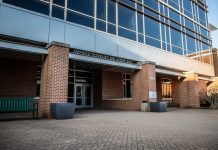


During SRU’s first Town Hall of the 2025 spring semester in the Smith Student Center Ballroom, Vice President of Student Affairs David Wilmes delivered updates on the recently outsourced Student Health Services (SHS).
Last semester in early October, AHN was officially named the third-party service provider after months of inquiry leading back to The Rocket’s initial reports in March of last year. AHN started providing services at the start of the spring 2025 semester.
“As I said, we spent the fall semester working with the nurses’ union and doing some closed-door meetings so this is really the first time that I can publicly share some of this information,” Wilmes said during the Town Hall. “The primary reason we did this was for financial considerations.”
The decision to outsource arrived after roughly one year of pushback from Office and Professional Employees International Union, representing staff members of SHS, and consideration through closed-door meetings, including at least one dozen meetings between the Future of Student Health Services Committee. The panel of six members tasked with assessing the feasibility of SHS operations.
As previously reported by The Rocket, an official report from the Future of Student Health Services Committee stated in December 2023 that “the committee does not recommend the 100% outsourcing of clinical health services provided to students.”
The report offered several alternatives to 100% outsourcing, but discussions persisted until October of 2024. The decision to outsource was ultimately favored due to a combination of financial feasibility and future scalability considering the coming “enrollment cliff,” as presented by Wilmes during the Town Hall.
Status of services
AHN’s operations are currently at 75% percent capacity, according to Wilmes.
Wilmes clarified in an interview with The Rocket that 100% capacity will entail the arrival of two nurse practitioners in March following accreditation. Currently one medical provider is on staff one day per week until March.
“I recognize that can be difficult for folks, especially if they want to go and see a nurse practitioner or a doctor, so we are working on it as best we can.” Wilmes said. “But ultimately, even though we’re dealing with this sort of window of a month of difficulty, when we come out on the other end, I think it’s going to be positive for students. I think we are going to have more opportunities for students, we’ve just got to get through this difficult period.”
Coverage and operations remain largely the same, according to Wilmes.
“The model that we are using stays exactly the same,” Wilmes said at the Town Hall, referring to SRU’s in-house model. “Students pay a single health fee every semester, that allows them to go to the health center as much as they want, our services have not changed.”
Although coverage will remain the same, three members from the in-house Student Health Center staff no longer will serve as medical providers in the new outsourced model. This includes Dr. Daniel Ferguson, who retired, and CRNPs Michelle Barron and Janet Flecker whose vacancies will be filled in March via AHN.
As of now, there is no increase to student health fees. Wilmes also noted students will not be billed insurance on site following the in-house model. The current service hours for SHS are 9 a.m. to 7 p.m. on weekdays and noon to 5 p.m. on Saturdays. Services remain closed on Sundays.
Wilmes highlighted a dedicated women’s health nurse practitioner, psychiatric services and emergency services as future goals.
“Our hope is that as we achieve these cost savings, we can shift some funding over to that area,” he said.
Mental health remains an area of concern at SRU, especially in light of the recently released American College Health Association’s National College Health Assessment survey. According to survey responses, 54.4% of SRU students reported being diagnosed with at least one chronic mental health condition in their lifetime.
Justification for outsourcing
The relationship between SRU and AHN dates to the COVID-19 pandemic, where AHN was contracted for pandemic oversight and recommendation.
“We’ve been talking about it for years, the pandemic hit, obviously that is not a time to make any changes with healthcare services,” Wilmes said.
After the pandemic, SRU’s SHS remained in-house until official talks occurred last year. Wilmes told The Rocket discussions have been underway in administration since around 2016 to 2017.
“We have been operating in a deficit in the Health Center since 2016. The Health Center is a million dollars in the hole and we were using University E&G funds to cover that deficit since 2016. So, it was time that we made some sort of decision about how we properly finance that area,” Wilmes said during the Town Hall. “As I said, we spent the fall semester working with the nurses’ union and doing some closed-door meetings, so this is really the first time that I can publicly share some of this information.”
According to official SRU financial records, in the years prior to the pandemic, SHS lost $30,059 in 2016, $111,340 in 2017, was $83,597 above budget in 2018, but lost another $96,927 in 2019. Following 2020, the university was losing roughly six figures per year peaking at a loss of $447,498 in 2022.
Besides the financial deficit, Wilmes noted a decrease in student appointments by fifty percent since 2017, stating it was “kind of hard to make the argument that we should raise the fees when our appointments are going down.”
“We also had a staffing model which really matched our older 24/7 model,” he said, noting SHS has not had a 24/7 model for at least four years prior to the switch.
An additional point Wilmes suggested was the looming “enrollment cliff,” a nationwide phenomenon showing consistently decreasing college attendance.
“We need to be prepped and ready so we can be nimble and responsive to the size of our student body, because we are not sure where our student body is going to be in five years, ten years,” Wilmes said.
According to Wilmes, there was an estimated $5.6 million to maintain the old model of SHS for the next three years, compared to $2.9 million with the AHN partnership.
“These are not easy decisions,” Wilmes said during the Town Hall. “But we’ve got to do what’s best for our students and what’s best financially.”