
College athletics has never been bigger. Between conference realignment, television contracts, the transfer portal and name, image and likeness (NIL) opportunities, the business side of college sports continues to grow.
Yet, despite the sport’s growth, attendance figures and increasingly noticeable empty seats have told a different story throughout the first half of the college football season.
Perhaps no example illustrates this better than Penn State, roughly 150 miles east of Slippery Rock in State College.
Penn State football has built a tradition of loyalty throughout the years, consistently ranking among the nation’s top programs in attendance. The Nittany Lions averaged 107,093 fans per game last season at Beaver Stadium, the fourth-largest stadium in the world and second-largest in the United States, behind only Michigan Stadium, a college football cathedral all too familiar to Slippery Rock football.
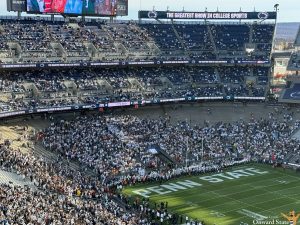
West Shore Home at Beaver Stadium broke ground on a $700 million renovation in 2023, with plans to add seats and expand the stadium’s capacity as part of a project expected to be completed before next football season. The Nittany Lions have already made history during the renovation, drawing a record crowd of 114,419 against the University of Southern California on Oct. 10, 2026.
Despite its history and continued success in attracting large crowds, Penn State has experienced a dip in attendance this season. Against Purdue, the Nittany Lions announced a crowd of 102,041, their lowest attendance since their final home game before the COVID-19 pandemic in 2019.
The numbers reflect a broader challenge across college football, as programs of all sizes attempt to keep fans coming through the gates.
Texas Christian University reportedly drew fewer than 33,000 fans for the Horned Frogs matchup against Kansas, its lowest-attended game in two decades. Maryland has also turned to promotional ticket offers and student incentives, including four-for-one ticket deals and tuition giveaways, in an effort to bring more fans into its stadium.
Even some of the top programs have struggled to consistently attract spectators. No. 7 UCLA entered its game against Nevada undefeated and enjoying its best start in two decades, yet still filled just 27% of the Rose Bowl’s maximum capacity.
The reasons behind attendance fluctuations vary from program to program. Rising ticket prices have made attending games less affordable, while conference realignment has weakened some of the regional rivalries that historically brought fans to stadiums. The transfer portal and NIL opportunities have also changed the relationship between fans and players, making it more difficult for supporters to establish lasting connections with individual athletes.
Additionally, the expanded College Football Playoff has changed expectations surrounding success. For some fan bases, anything short of championship contention can make a season feel disappointing, potentially affecting the willingness to attend games.
While those challenges are particularly noticeable among major Division I programs, smaller universities face their own obstacles. More than ever, schools like Slippery Rock are depending heavily on students, alumni, families and surrounding communities to create a home-field advantage.
Last season, The Rock averaged 7,599 fans across its five home games, nearly 2,500 more per game than the next-closest program, West Chester, which averaged 5,128. Kutztown followed at 4,006, while IUP averaged 3,952 and Shepherd drew 3,915. Slippery Rock’s average attendance alone surpassed the total season attendance of three other PSAC programs, despite those schools playing just as many, if not more, home games.
Perhaps most impressive, Slippery Rock posted those numbers during what was its worst season in more than a decade.
The Rock’s following extended beyond the Division II level in 2025, as SRU averaged more fans per home game than 91 Division I programs nationwide, including nine of the 13 Division I football programs located in Pennsylvania.
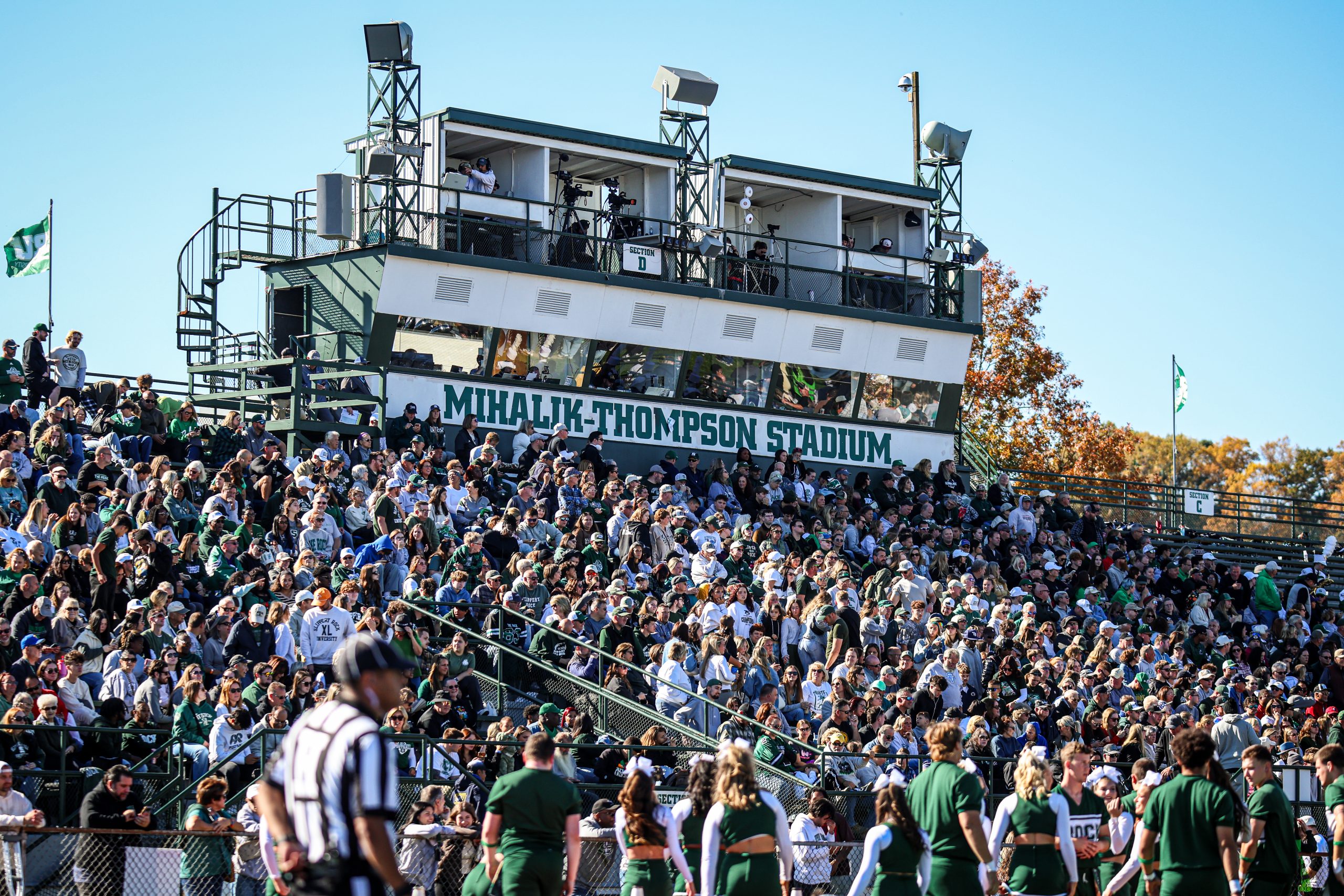
Throughout the 2026 football season, Slippery Rock has continued to attract spectators to Mihalik-Thompson Stadium. The program welcomed 7,797 fans for its season opener against Minnesota Duluth before drawing 7,338 for its matchup against Gannon. The largest crowd of the season came Oct. 24, when 9,817 spectators watched Slippery Rock defeat Lock Haven 66-7 on Homecoming.
Attendance would decrease over the next two games, with SRU drawing an average of 2,590 fans. Rain, wind and below-freezing temperatures contributed to the drop, highlighting how factors beyond a team’s performance can influence attendance.
Still, the connection between a program and its community remains an important part of college football, particularly at the Division II level.
With an undefeated regular season and a conference championship secured in 2026, Slippery Rock has given its supporters plenty of reasons to keep showing up. As college athletics continues to evolve, ticket prices, conference realignment, player movement and shifting expectations will undoubtedly influence how fans engage with their programs.
For Slippery Rock, however, the support surrounding the program demonstrates the importance of community in college football, especially at the lower levels.