


One of the goals of Turning Point at SRU is to bring speakers to campus who can address issues that are important to our community, our state and our nation. By “important,” I mean issues that matter, that make a difference in people’s lives and that are often complex and need to be discussed rather than ignored.
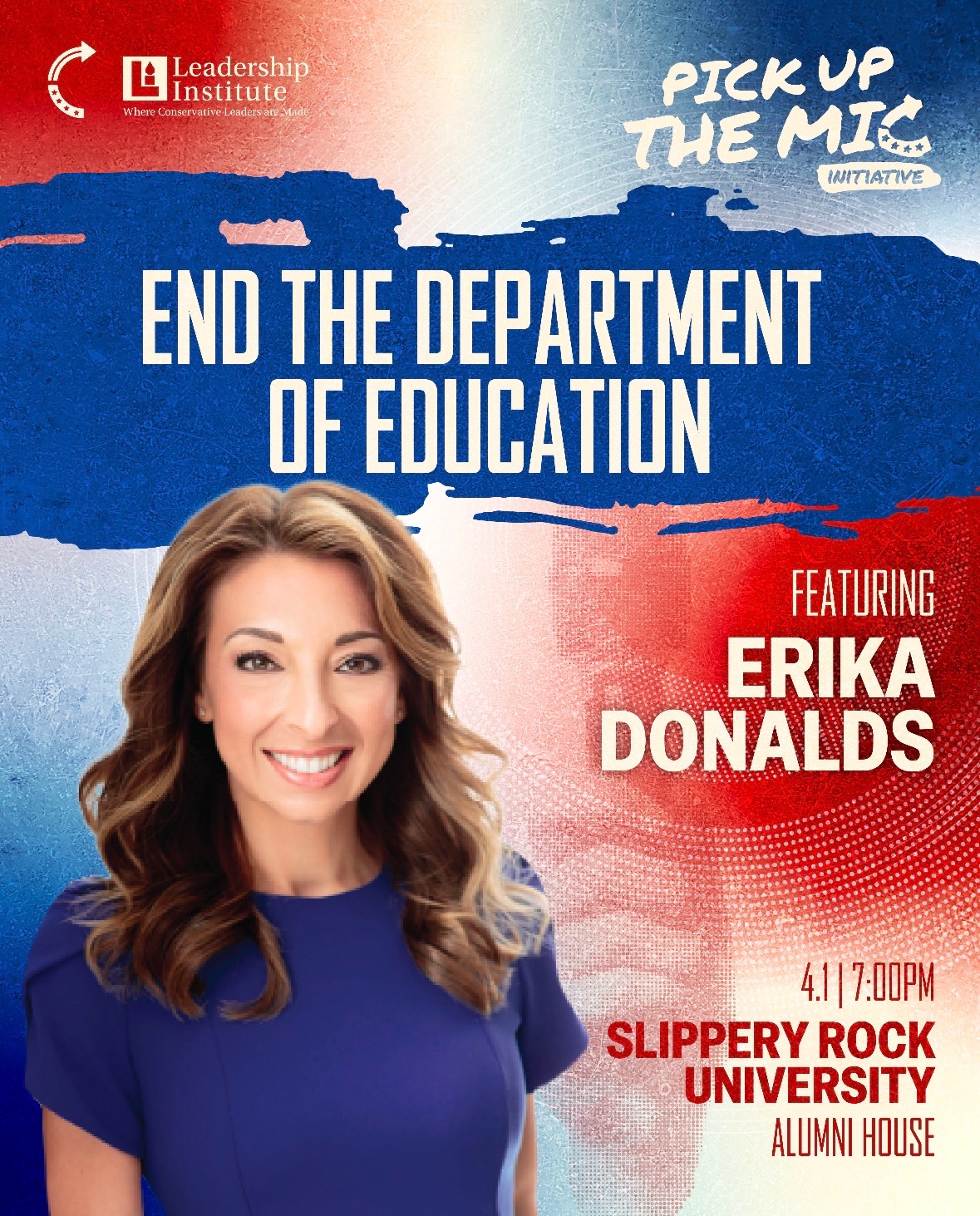
By now, you may have heard about our speakers who are coming to campus this semester. Our first speaker is Erika Donalds, an education policy expert who has advocated for school choice. She will be discussing the U.S. Department of Education on April 1 at 7 p.m. in the Alumni House.
In-person and online, we’ve seen a lot of people asking why we would host this speaker at a university that was once a “teachers college,” and which made a name for itself with its education department. The truth is, the university did not make this invitation; it is only serving as the host for a speaker we selected to discuss an important issue: eliminating the U.S. Department of Education.
Some ask why we would invite this particular speaker to campus. Well, there are multiple reasons that are directly related to the university’s efforts to train future teachers.
First, there are many misconceptions about the U.S. Department of Education—in fact, it does not even do what most people think. For example, one student asked me, ‘if we get rid of the Department of Education, how will teachers be paid?’ My response was that teachers are not federal employees and do not get paid by the Department of Ed. This conversation went on and on, but the larger point I am making is that people do not understand how the system works and are taking uninformed positions on the issue.
I would also argue that the U.S. Department of Education does not help us as students. While states and local school districts may claim to have power over curriculum and federal funding, regulations and standards can put pressure on state and local decision-makers to adopt perspectives that people in Washington, D.C., think are best for us.
Some may also argue that student loans would be put in jeopardy if the department were to be eliminated, but this responsibility would be shifted to another agency with expertise in grants and lending. Eliminating a layer of administration, reporting and duplicative oversight could save taxpayers money and return control to the local level.
My second reason for bringing Donalds to campus is to speak on school choice, a hot-button issue in Pennsylvania. She is on councils in Florida helping to push for the idea that students and their parents have the right to choose how they learn and where they learn. This can include charter schools, private schools, other public schools, etc. Not everybody is the same; we all learn in different ways that are best for us.
Teachers need to teach students how to think, not what to think. Many times, in high school and even at this university, I have had teachers throw their political beliefs into the curriculum that they are teaching to shape what kids think. Instead, teachers should teach the younger generations to ask questions, look for evidence and be critical of things they see.
Future teachers should be asking questions also, even questions about school choice and ending the U.S. Department of Education.
Please, if anything I said at all interests you—whether you agree or disagree—please come to our event and ask your questions during the question-and-answer section. Tickets are completely free at sru.universitytickets.com.
Now I will leave you with this: If you teach a generation how to think for themselves, they have the possibility to change the world. But if you teach them what to think, life will become stagnant with no advancement. Which world would you want to live in?