

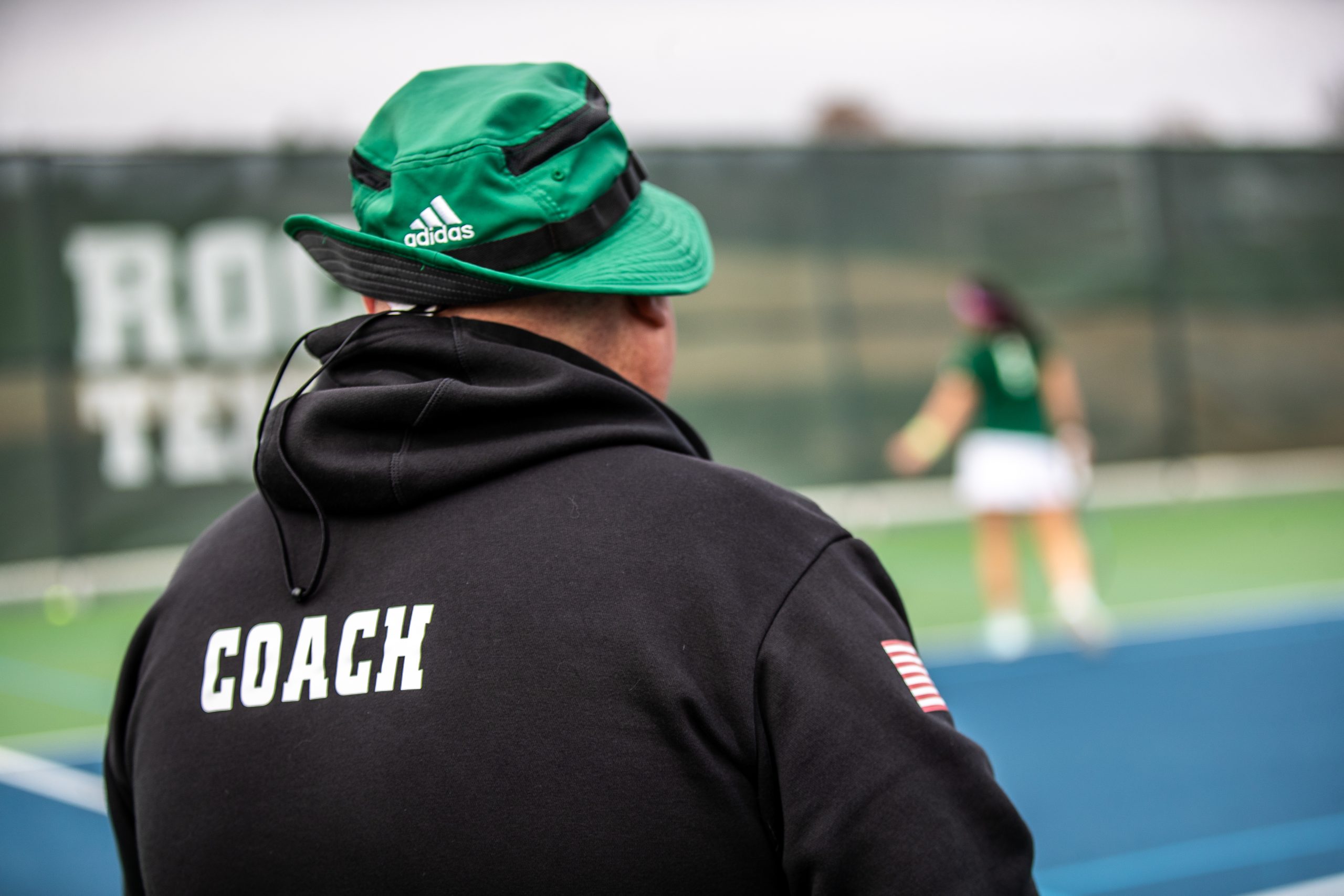
Slippery Rock University has a coach with eight Pennsylvania State Athletic Conference (PSAC) Coach of the Year awards. It has a coach with 19 NCAA Tournament berths. It has a coach that has overseen four PSAC West Athletes of the Year, seven PSAC West Freshman of the Year and 73 All-PSAC honorees. It has a coach with 387 career wins.
His name is Matt Meredith.
First time at Slippery Rock
Meredith first came to Slippery Rock University as a student. Wanting to work in education and play tennis, he narrowed his search down to two schools.
“Back then, my goal was to become a social studies teacher,” Meredith said. “It was between here and Edinboro. I chose here because I love the campus, and I liked the coach as well.”
In his time playing tennis with the White and Green, Meredith earned two team Most Valuable Player awards, was a team captain twice and earned three varsity letters.
He graduated from The Rock with his bachelor’s degree in secondary education and social studies in 1992. He then found an opportunity to coach tennis working with his own high school. He got a taste of coaching success early on, going 12-1 at DuBois high school in 1993.
“I was lucky to say that I think we only lost one match that year and we had a really good team,” Meredith said. “It was fun to do for the year.”
After his time at DuBois, Meredith set out for Philadelphia looking for a permanent teaching position.
“I was working 80 hours a week…I was teaching tennis, substitute teaching, trying to get a permanent teaching job,” Meredith said.
His time in Philadelphia was spent with the Bucks County Racquet club. After over three years, he decided to come back to SRU to work on higher education.
“My goal was to come back here and work on my master’s in special education and look to get a job that way,” Meredith said.
While here though, Meredith started to realize the potential of combining two of his lifelong passions into one career in the form of collegiate tennis coaching.
“What is enticing to me is, it’s both worlds. I have an academic world where I’m still involved in dealing with and making sure kids are learning and doing those things and being the best they can academically. Tied in with the tennis part, it was a no-brainer for me.” Meredith said. “It allowed me to do both and make a living, and my passions for both can be achieved at the college level.”
The coach still keeps working with younger players as well though, leaving his summers open for training with newcomers in his journey to spread the sport in America.
“Here I get to do all different kinds of levels. I have my high-level kids on my team and then I also, in the summer, I have down to beginner kids, little kids that are just developing, so those are all aspects I love to do… tying it together at the college level is the right move for me,” Meredith said.
A new opportunity
It was in his second go-around with the University that Meredith started to get his foot in the door for a potential coaching position. The tennis coach at the time, and Slippery Rock Athletics Hall of Fame member James P. McFarland, helped Meredith with getting a graduate assistant position in the intramurals office.
It was not long though, before it was McFarland’s time to retire. Meredith quickly had his hat in the race for the head coaching job, but did not instantly get it.
“There was a year where I didn’t get the job. I was in transition.” Meredith said.
He worked as an assistant coach at The Rock in 1996, but by 1998 he got the head coaching job of the women’s tennis team and has never looked back.
Meredith attributes his coaching style in part to three people who helped him get where he is. Among the two were McFarland and Meredith’s father, who he said was an athlete who taught him how to compete.
The third was Paul Wysocki, a tennis coach from Meredith’s younger playing days.
“He was always positive; he was never a negative person… I try to be positive. There’s times when you have to be, ‘Ok, what are we doing here?’ but overall you need to be positive, because positive things lead to positive things,” Meredith said.
Part of Meredith’s own coaching developments has been a heightened focus on the mental game.
“The main thing that I’ve brought more focus into is the mental toughness part of the game. We’ve really worked on that part of the game in the last five years,” Meredith said. “That has developed into how we develop our players and understanding how they function on the court.”
While he learned years ago many of the lessons that made him the coach he is today, Meredith still stresses the importance of continuing to learn.
“If you’re not adapting and learning and doing, you shouldn’t be coaching either,” Meredith said.
A similar principle applies when Meredith is recruiting new players.
“There’s two things that I look for when I look. One is, they definitely have to be good students. I am lucky that tennis generates a lot of good students. They also have to be a fairly good level too, because we are a very good level here of DII,” Meredith said. “It’s finding somebody who wants to be here and can handle the pressures of our level.”
Meredith said the consistent roster turnover that comes with being a college sports team changes the way the players interact with Meredith and each other, but a few constants remain.
“We all have our journey or goals and stuff like that to bring it back into where we can be similar,” Merdith said. “The dynamic is unique. Tennis is a team sport that plays as an individual.”
One of the primary constants is the necessity of competition within the team in practice that comes with the uniqueness of tennis.
“That’s a whole different dynamic than any other team sport,” Meredith said. “Usually other teams sports are, ‘ok we are going to work together, we’ve got to know what this person or this person is doing.’ Tennis is not necessarily that.”
To Meredith, the individuality is part of the beauty of the sport.
“It’s you against an opponent. There’s not too many sports left in college that have that one-on-one,” Meredith said.
When playing with team scores though, players are still reliant on each other to win their own matches. It is impossible for one athlete, no matter how dominant, to carry their entire team to a win.
“It’s the greatest sport ever…You go out with your teammates and when you’re playing, there’s nothing like it. You’re functioning as one,” Meredith said.
This aspect of tennis adds a level of complexity to game planning that is not present in every sport. If an athlete is struggling, they can not just rely on teammates to make a play or rely on someone to switch up a formation to completely change the flow of a game.
“It’s about how I’m going to go against this person. How I’m going to adapt if I need to and be able to defeat somebody. That to me makes it a thrilling thing and makes it very passionate in what we do,” Meredith said.
As a result, Meredith says athletes have a lot to learn from tennis that helps in other parts of life.
“Tennis builds a lot of character. Its you against them. You have to figure it out. That aspect of the game teaches you so much in every part of your life,” Meredith said.
Team building
The Slippery Rock women’s tennis team has a large presence of international recruits.
“The number one sport in the world is soccer, the number two sport in the world, guess what it is. It’s tennis.”…“There’s a lot of players out there internationally as well as here,” Meredith said.
This means two things for Meredith. For one, he can look across the world while recruiting student athletes. For the other, the team brings together plenty of different people from different walks of life.
“We try to run it as a family. We are very family-oriented in the fact that we’re all in this together,” Meredith said. “The thing is, because we’re a small team, it’s easy to bond with each other.”
The coach recognizes the need to occasionally be stern with his team along with all the good times.
“There’s times that I have to be a little bit more of a pain in the butt than other times and that’s part of being a family,” Meredith said. “There’s hard things with families and there’s easy things with families, but at the end of the day, we’re family. And that’s how I try to relate to my players.”
One of the most impactful moments Meredith experienced with The Rock was helping out with building houses in Houston at the 2008 NCAA Division II Festival.
“We got to do a habitat build. It was amazing, it really was. I get emotional talking about it because you get to meet the people you build this house for. I’m out with my team and it’s hotter than heck down there in Houston—the humidity is unbelievable—and we’re out there framing a house, and we got to meet the guys that were volunteering to do that,” Meredith said. “That whole experience… wow.”
Tennis is and will always be a large part of Meredith’s life, but seeing the development of people within and because of the sport is also massively important to him.
“My goal every year for this program is to win a conference title and to get as far as we can in the NCAAs,” Meredith said. “The other thing is to make sure that we’re producing quality student athletes. We are very proud of our grade point average.”
What goes for academics also goes for these athletes as they go on into the portions of their lives after collegiate athletics.
“You look back at the young people, what they have done, it’s not always about tennis, it’s watching them develop into their families and now they’re having kids and so forth and so on,” Meredith said. “That’s the most proud I could be as a coach.”
What an experience
During his time at The Rock, Meredith has coached for over 26 years, claimed over 370 victories, earned an NCAA Tournament berth in well over half of his seasons and finished with fewer than 10 losing records.
The eight-time PSAC Coach of the Year is the winningest coach in PSAC history and has three regional titles and one PSAC Championship.
In just his second season with the White and Green, the 1990-2000 season, he guided his team to the NCAA Tournament for the second time in SRU’s history.
The next season saw Meredith’s first winning record with The Rock and another NCAA Tournament berth.
The 2001-2002 team was the first team in program history to record 20 wins in addition to their NCAA Tournament appearance that included a first-match win. It also marked Meredith’s first time winning the PSAC West Coach of the Year award.
Just another year later, and the White and Green won the PSAC Championship under Meredith with a plethora of other awards and accolades being given to the team.
In 2004-2005, Ashley Michaux became SRU women’s tennis’ first ever PSAC West Athlete of the year.
2006-2007 saw Slippery Rock again reach new heights with a 23-6 record and another first round NCAA Tournament win.
It would only take two more years for the 2009-2010 team to register the furthest finish for the program in the NCAA Tournament as the White and Green reached the quarterfinals. Meredith earned his 200th collegiate victory in the same year.
By 2018, Meredith won his 300th.
In the 2023-2024 season, Meredith was named the Edwin J. Faulkner College Coach Award winner by the United States Tennis Association Middle States section (USTA). The award is bestowed upon a person who has displayed exemplary achievements toward the growth of tennis.
Nearing the end of the 2025 spring season, Meredith is closing in on win number 400 as his career record sits at 387-222.
Across his 26 completed seasons, Meredith’s teams have made the NCAA Tournament 19 times. He has eclipsed double-digit wins 20 times and gotten to the 20-win mark six times, including four times in a row from 2006 to 2010. His teams have never lost more than 13 matches and have not lost double-digit matches since 2018.
“You’ve got to thank the players. All the players go out there and develop me as a coach…It’s always something new and exciting that you can build upon,” Meredith said.
He mentioned he wants to stay around tennis for as long as his life allows, and tennis will never not be a part of him.
“As you get older… I’m proud of what I’ve done here. Its been a great avenue for me, for my family, for all the kids I’ve had on my teams. What an experience. What a life,” Meredith said. “And you don’t take it for granted because there’s going to be a time—and I know it’s coming up—where I’m going to step away. And that’s closer to what it is than 27 years ago when I started. That’s a little closer, so you don’t take it for granted. You enjoy the ride. Enjoy the journey.”